
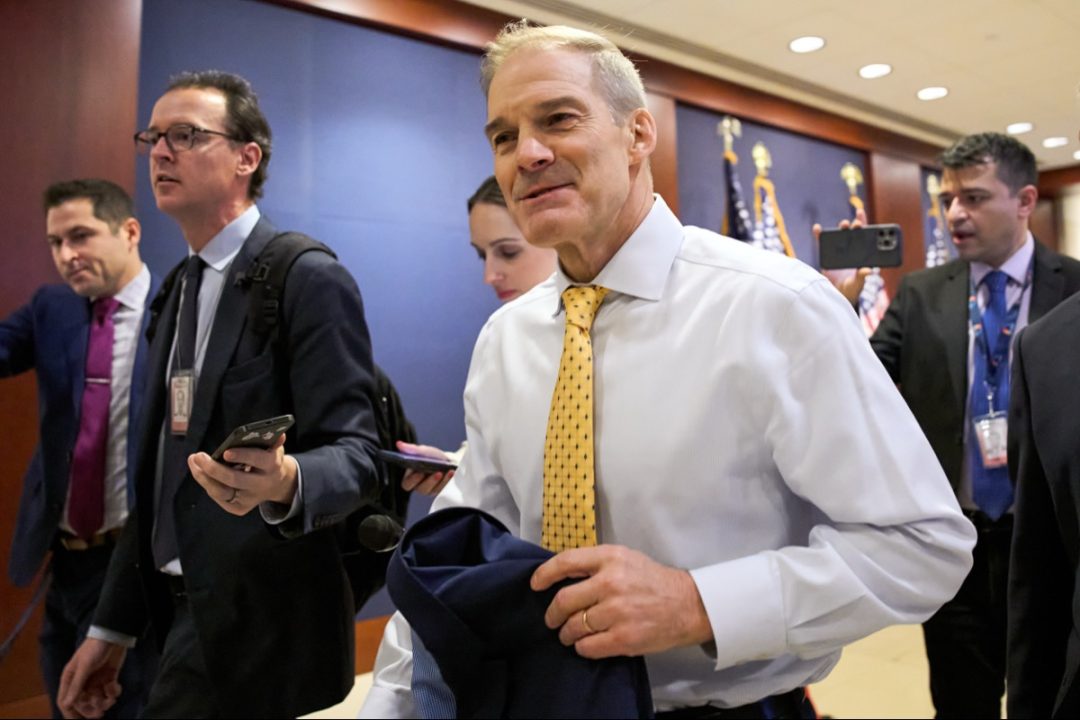
Jim Jordan Picked for New House Minority Leader
House Republicans have elected a leader with a fighting background to guide them in a Congress that promises to be fraught with intense partisan battles. Representative Jim Jordan (R-Ohio) defeated Steve Scalise (R-La.) 106-73 by secret ballot on Tuesday for the title of House Minority Leader.
The outgoing speaker, Mike Johnson (R-La.), decided immediately after last week’s trouncing not to seek the leadership role. Johnson was reelected to the House in the midterms with 58 percent of the votes.
The “Original Congressional Brawler”
Fellow Republicans have hailed the former high-school wrestling coach as “the original congressional brawler” the GOP will need. A co-founder of House Freedom Caucus, Jordan was all smiles after winning the position. “Over the next two years, House Republicans will fight for American families,” he said during a post-vote press conference. “When Democrats offer more government, we’ll offer more freedom, and we will bring that fight in committee, on the floor, and on the stump every single day.”
Many social media responses to Jordan’s comments echo a common frustration among GOP voters. People posted a slew of angry remarks, many of them some iteration of “Yeah sure — why didn’t you do this when you were in the majority?” This exemplifies the popular belief that the GOP squandered a golden opportunity to right the ship over the last two years.
Jordan has served as the chairman of the House Judiciary Committee since 2023. He is known for his combative approach, but his ire has been almost exclusively partisan. He went hard after former Justice Department special counsel Jack Smith for the lawfare he carried out against Donald Trump before he was reelected. But when then-Attorney General Pam Bondi appeared before the committee, he had no problem with the way her agency handled the Jeffrey Epstein files.
Trying Times Ahead
Jordan told fellow Republicans before Tuesday’s vote that he’s the man they need in what are sure to be trying times. Democrats already have a 254-169 majority as of this writing, and are projected to take 259 seats. “I am battle-tested on the oversight front and I know the Democrats’ playbook. I know what it will take to lead our Conference in the minority, to stay unified, and to coordinate and calibrate our response to the Democrats’ tactics,” Jordan wrote in a letter to his colleagues. “In these next two years, our job cannot be merely to spotlight how radical this new Democrat party is — offense, not defense, wins elections.”
Representative Jamie Raskin (D-Md.) read Jordan’s election as a sign that Republicans are gearing up more to fight than to “work” with Democrats. Mainstream analysts interpret his election the same way. CNN’s Sarah Ferris wrote, “[Jordan is] a high-octane former wrestling coach, with the ability to act as a political attack dog in a way that his allies said his challenger, House Majority Leader Steve Scalise, lacks.”
Mediocre Constitutionalist
Legacy media dub Jordan a “hardliner,” one of the “most combative figures,” and an “ultraconservative.” There is some truth to that, especially the combative part, but his voting record suggests he has only an average understanding and respect for the Constitution.
Jordan’s score in our Freedom Index is 82 percent, very good when compared to most others in Congress, but no more than respectable when measured against constitutional principles. His record is better than that of Scalise, who has a score of just 66 percent, and that of the outgoing speaker — Johnson’s Freedom Score is 70 percent. Ironically, Johnson is a constitutional lawyer by trade.
Jordan has been a mainstay on Capitol Hill for nearly two decades, and is in his 10th term. The current congress is among his worst when it comes to voting in line with the Constitution. His score for the 119th congress is 77 percent; only his first term was worse, at 74 percent.
The Good and the Bad
Jordan’s voting record, like his approach in hearings, suggests he’s prone to partisan team sports. He rightly opposed more Ukraine aid, but voted against the War Powers resolution to rein in Trump’s unconstitutional war on Iran. Ironically, the Iran War is widely recognized as the primary reason Republicans were routed so badly last week.
Jordan also voted for an extension to FISA 702, which allows intelligence agencies to spy on American citizens without a warrant. He voted to appropriate $187 billion to a slew of agencies that don’t have constitutional permission to exist. And he voted for the GENIUS Act, which expands government surveillance and control over private financial transactions and creates a backdoor for a central bank digital currency (CBDC).
But he did vote to prohibit the Federal Reserve from issuing CBDCs. He also voted to strike all funding for the Office of Energy Efficiency and Renewable Energy (which was later absorbed into the new Office of Critical Minerals and Energy Innovation). He voted to eliminate $118 million in foreign aid, opposed taxpayers footing the bill for sex changes, and voted for Representative Thomas Massie’s (R-Ky.) “kill-switch” amendment, which, had it passed, would have banned mandatory drunk-driving technology in new vehicles.
Third Time the Charm
This is the third time Jordan has sought to lead House Republicans. He ran in 2018 and in 2023, when Kevin McCarthy prevailed as House speaker only to be dramatically bounced out nine months later by a Matt Gaetz-led mutiny. Jeffrey Blehar of National Review says the reason Jordan finally won is because “everybody who hates him … lost their election on Tuesday night.”
He will take the helm of a Republican House minority that hasn’t been so diminished since the 1990s, possibly the ’80s, depending on how the outstanding races shape out. The GOP will need a fighting spirit at the helm, and Jordan has the opportunity he has long coveted. If he does well and Republicans manage to pull off a miracle and take back the House in 2028, he would be in position to become House speaker. That’s a big if, but he has undoubtedly already dreamed of it.