
Report: Most Immigrants Get Some Form of Welfare; 61 Percent of Illegal Aliens Do
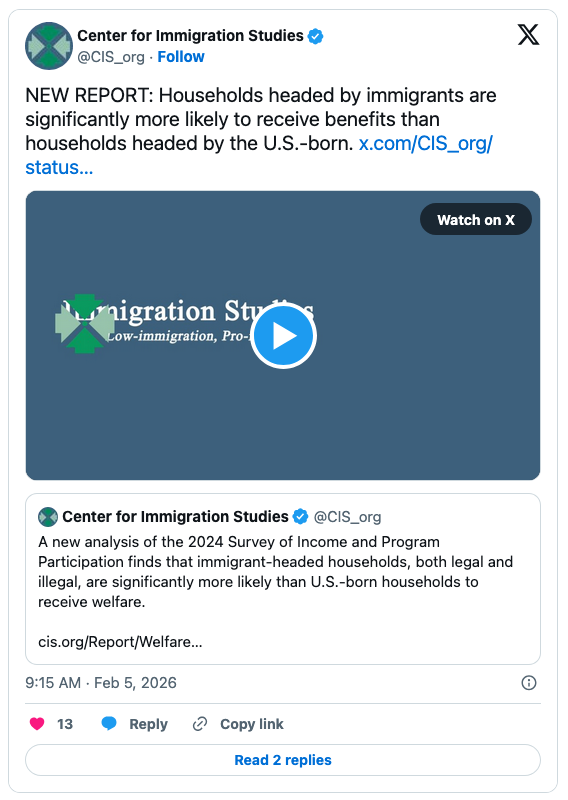
In yet another report the far-left, open-borders media will ignore, the Center for Immigration Studies (CIS) has revealed that a majority of immigrant households — more than 50 percent — are on welfare.
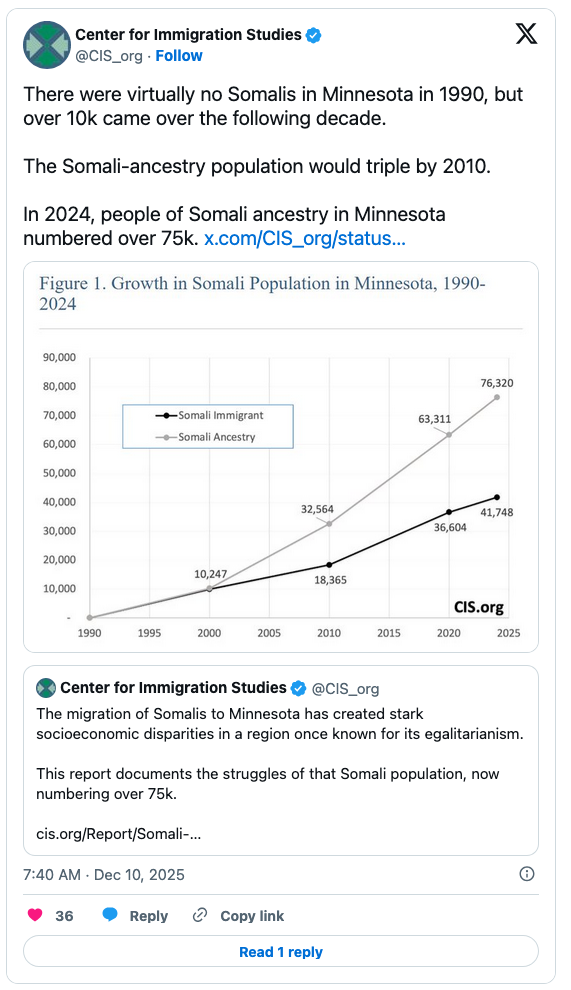
The news comes weeks after CIS disclosed that almost 90 percent of Somalis in Minnesota receive some form of welfare, a not-so-shocking revelation that piled atop the Somali welfare fraud scandals.
Upshot: Immigrants are a bottomless drain on taxpayer resources and contribute virtually nothing to fiscal health or federal and state treasuries.
Overall Data
With data from the 2024 Survey of Income and Program Participation, CIS calculated that 53 percent of immigrant-headed households, which include naturalized citizens, legal residents, and illegal aliens, are using at least one major welfare program. Just 37 percent of American-born households use a welfare program.
Welfare use by noncitizen households, meaning illegals or green-card holders, is 59 percent.
One big drain on taxpayers is feeding the immigrants and giving them free health care. “Compared to households headed by the U.S.-born, immigrant-headed households have especially high use of food programs (35 percent vs. 22 percent for the U.S.-born), Medicaid (39 percent vs. 27 percent for the U.S.-born), and the Earned Income Tax Credit (15 percent vs. 10 percent for the U.S.-born),” the report of more than 12,000 words explained.
As well, illegals use welfare at a much higher rate than legal immigrants: 61 to 51 percent. CIS observed that it did not adduce evidence that fraud is at work, although the Somali shenanigans in Minnesota might well suggest rampant fraud.
“No one program explains the higher overall use of welfare by immigrants,” CIS continued:
For example, excluding the extensively used but less costly school lunch/breakfast program, along with the [Women, Infants, and Children] nutrition program, still shows that 47 percent of all immigrant households and 34 percent of U.S.-born households use at least one of the remaining programs.
Broken down, the numbers show 59 percent of noncitizen-headed households are on welfare, and 53 percent of immigrant-headed households are. As well, 21 percent of illegal- and legal-immigrant households get cash assistance, 44 and 32 percent respectively get food assistance, and 44 and 38 percent glom onto Medicaid.
Drilling Into the Data
Not surprisingly, new immigrants and those ensconced here for some time use welfare at similar rates. For those here less than a decade, the rate is 48 percent. For those here more than a decade, it’s 54 percent.
Yet “the high welfare use of immigrant households is not explained by an unwillingness to work,” CIS explained:
In fact, 86 percent of all immigrant households have at least one worker, compared to just 74 percent of U.S.-born households. Income determines welfare eligibility, so many low-wage workers access welfare.
Immigrants’ higher welfare use relative to the U.S.-born is partly, but only partly, explained by the larger share with modest education levels, their resulting lower incomes, and the greater percentage of immigrant households with children.
However, immigrant households without children, those with higher incomes, and those headed by well-educated immigrants tend to be more likely to use welfare than their U.S.-born counterparts.
The question is how immigrants who are forbidden from receiving most welfare get so much of it. Answer: They collect benefits because of their anchor-baby kids; the prohibition excludes some programs; “most legal immigrants have lived here long enough to qualify for welfare”; some states provide their own welfare; and naturalized immigrants, can, of course, jump on the dole the minute they take the oath of citizenship.
The big problem with immigrants on welfare isn’t just the money they collect — it’s the tax revenue they don’t contribute.
“The federal government spends roughly one trillion dollars each year collectively on the above programs, which represents a substantial share of the federal budget,” CIS reported:
State governments also spent over $300 billion a year on Medicaid. Looking at welfare use provides insight into whether immigrants or the U.S.-born are a net fiscal burden. This is not simply due to the direct costs they create, but also because those accessing means-tested programs typically pay little to no federal or state income tax, which is by far the largest source of federal revenue.
And because immigrants are vacuuming so much tax money, less is available for the poverty-stricken here before them. CIS also explained that taking “welfare is a key measure of self-sufficiency and therefore is an important measure of how immigrants are adapting to life in America.”
Somalia Welfare Bonanza
While CIS warned that the high rate of welfare use shouldn’t be seen as immigrants “gaming the system,” that might not be the case with Somalis in Minnesota, apropos of the major welfare fraud operations in which they are involved. Almost 90 percent of Somalis get some form of welfare.
In December, CIS disclosed that the Africans, who speak little if any English and are virtually illiterate, are a sinkhole for tax dollars. Almost 40 percent live below the Census Bureau’s poverty line, and 52.3 percent of kids in Somali immigrant homes live in poverty.
“Among the strongest predictors of poverty are low education and lack of English-language ability,” CIS explained, problems that Somalis exhibit “at dramatically higher rates” than real Minnesotans.
“Virtually all native Minnesotans speak English very well, for example, but 58.2 percent of working-age Somalis do not,” the report continued. Almost 40 percent don’t have a high-school diploma, and 21.6 percent of working-age Somali men are unemployed.
“While just 6 percent of native households in Minnesota receive cash welfare — including Temporary Assistance for Needy Families, Supplement[al] Security Income, and general assistance — 27 percent of Somali households do,” CIS reported:
The disparities are even greater for food and medical care, with over half of Somali households receiving food stamps and nearly three-quarters using Medicaid. Altogether, 81 percent of Somali households consume some form of welfare, compared to 21 percent of native households. Somalis with 10 years of residency have welfare consumption rates that are only marginally lower than the Somali population as a whole.
Those shocking data typically involve households with kids, and 86 percent of the African households with kids use Medicaid.