
UN Biodiversity Summit Injects Pagan Spirituality Into Global Governance
YEREVAN, ARMENIA — Behind the UN Convention on Biological Diversity’s (CBD) narrative about protecting nature lies a much more sinister agenda. A key element of that involves demoting man from the pinnacle of creation, as outlined in the Bible, while elevating nature to a pagan-style quasi-deity whose “rights” and “spirits” supersede human liberty, property, and biblical stewardship. The implications of this shift are hard to overstate.
The so-called “Yerevan Pathway,” the main agreement to emerge at the UN CBD’s 17th Conference of the Parties (COP17), advanced the not-so-hidden worldview transformation in unprecedented ways. Most importantly, the deal institutionalized “indigenous” animism and “traditional” knowledge systems that treat humans as just another species — more destructive than cockroaches, perhaps, but not special in any way, and certainly not made in the image of God with a mandate to have dominion over the planet, the trees, and the animals.
As at other UN summits, especially “climate” conferences over the last few decades, top UN leaders, global bureaucrats, and tax-funded activists repeatedly prayed to and bowed before forest deities and river spirits. The Christian understanding of nature and man’s place in it, however, was conspicuously absent, except as a punching bag to demonize.
Despite UN claims, this is not about “conservation” in any legitimate sense. Instead, it represents a coordinated and diabolical attempt to re-paganize the world and overthrow the march of Christian civilization and all that entails — individual liberty, rule of law, free markets, prosperity, and more. It fits neatly within the pattern The New American has documented for decades as powerful forces seek to forge a new world religion bringing all traditions into harmony with the UN agenda.
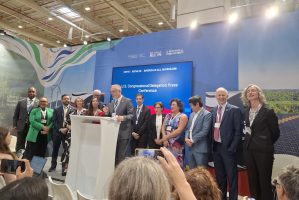
As at COP30 of the UN Climate Change Conference (UNCCC) in Brazil, where indigenous rituals, prayers to nature spirits, and interfaith coalitions framed climate action as a holy cause replacing biblical authority, CBD’s COP17 put “indigenous wisdom” at the center. The venue filled with native peoples in feathers, bead necklaces, and face paint. Prayers and invocations to pagan deities were ubiquitous, with European delegates and global bureaucrats standing in deference.
The barely concealed real message came through loud and clear: Before “evil” Christians arrived, peaceful pagans around the world lived in glorious harmony with nature — never mind the cannibalism, human sacrifice, and genocide that was ubiquitous. The solution to the supposed “biodiversity crisis,” then, must be a return to the values and even spirituality that were displaced.
Institutionalizing the New Priesthood
If one idea united nearly everyone at COP17, it was that primitive “indigenous” peoples untainted by Christian civilization hold the necessary wisdom to protect nature. In fact, the summit created the framework for a new permanent body within the CBD that will formally inject “indigenous” thinking and influence into the whole process, in perpetuity, with operating rules known as the Sevan Guidelines (named after an Armenian lake).
One co-chair of the body is nominated by governments, the other by UN-backed “Indigenous peoples’ organizations.” “Friends of the Bureau” seats further embed non-state actors. Jennifer Corpuz of the International Indigenous Forum on Biodiversity celebrated the “historic adoption,” saying it strengthens inclusivity for “rights-based implementation” while allowing indigenous groups to use their own governance systems.
This is a deliberate dilution of state sovereignty in favor of a parallel legitimacy structure that can be activated against resisting governments. As The New American reported from the Amazon climate conference, the UN has long trained “indigenous” representatives — often paid by taxpayers from developed nations — to parrot the agenda in traditional garb for photo ops.
The new UN CBD body co-led by an “indigenous” leader will have vast powers under Article 8 of the scheme. Among others, it will advise governments, draft agreements for the UN’s members, and shape guidelines for the “30 by 30” plot to lock up 30 percent of all land and water by 2030. It also sets a potential precedent for other UN processes to start injecting nongovernmental pagan leaders into formal international negotiations.
Separately, the International Union for Conservation of Nature (IUCN), a powerhouse organization founded by British humanist/eugenicist UNESCO boss Julian Huxley that works closely with the UN’s “biodiversity” machine, is moving in the same direction. For example, it now recognizes “Indigenous Peoples Ambassadors for Primary Forests,” including leaders from the Amazon, Congo, Thailand, Indonesia, and Gambia.
The rhetoric of these indigenous peoples ambassadors consistently frames nature as family and even deity. One described forests as carrying “ancestral stories” tied to survival. Another spoke of the deep connection with nature “as our mother, our brother, our soul and spirit,” cut off by eviction and criminalization.
While these ambassadors may be sincere in their convictions, the danger of mainstreaming paganism like this is enormous. The threat is not that some tribe in a jungle somewhere practices its traditional religious beliefs or has views deifying nature. It is that international political institutions are elevating dangerous religious and philosophical concepts into the foundations of public policy, at the expense of biblical truth, property rights, and self-government.
Voices of the New Spirituality
Indigenous leaders all over the UN summit were open about their views. In an interview with The New American at the summit after he came off stage from speaking, Sol Kaho‘ohalahala (“Uncle Sol”), a Hawaiian representative with Greenpeace International credentials, explained his tradition’s relevance to the UN’s “global community” in harmony with nature.
In his genealogy, he said, people emerge from the deep sea; the first creature is coral formed from “the energy and the biodiversity or the sediment.” Creation proceeds through the water column, reefs, land, and mountains before humans arrive millions of years later. “By the time we’re ushered into this space — the Honua, our home, Earth — we acknowledge that all of the things created before us, we are part of it,” he said. “So all things in nature, we belong to.”
In his faith tradition, reciprocity, not dominion, is the order of the day: Take only what is needed and give back, or nature suffers. As an example of what happens when that is not followed, he pointed to alleged man-made global warming. Climate change is “the earth really calling out and saying, ‘hey, I need some help here’,” Uncle Sol explained.
All indigenous people everywhere apparently agree with this perspective that humans are just part of nature and that they must learn how to govern from nature. “It is our view, and it is a global view — it’s not just a Hawaiian view, it’s a global view of indigenous people globally — … that we know this relationship with nature,” he continued, saying these “indigenous perspectives” were needed in international decision-making.
Celebrating the fact that religion and spirituality were playing a greater role in advancing the UN biodiversity agenda and other elements of the UN plan, he said that influence needed to keep growing. “We need to integrate and include indigenous thought, indigenous knowledge, indigenous experiences and practices to help create governance.”
Ultimately, the divisions between peoples and nations must give way to a global community to save the planet. “Our vision is one that incorporates everyone globally,” added Uncle Sol, who has worked with U.S. authorities and the UN for years. “We need to begin erasing those lines that have been placed on the Earth and have divided people, have divided resources, and have divided authorities, as though we’re individual units. We’re just one unit.… We are here to envision a global community that is going to be sustainable for all of humankind.”
These are not merely abstract theological disagreements. When spiritual beliefs about the supposed rights of rivers, forests, and ecosystems are incorporated into international governance, they can become the justification for restrictions on private property, agriculture, energy production, and other productive human activities.
The emerging doctrine of “Rights of Nature,” already incorporated into legal systems in various jurisdictions, illustrates how treating creation as a rights-bearing entity can transform environmental policy into a direct challenge to traditional understandings of property rights and human dominion. And when unelected international bodies are empowered to promote these doctrines, the implications extend far beyond religion into questions of sovereignty, liberty, and constitutional government.
At the COP17 Faith Hub, organized with the far-left World Council of Churches (WCC), pagan theologian Jocabed Solano of Panama shed more light on the thinking animating this whole process. For instance, she declared that the “three crises” of climate, biodiversity loss, and desertification were really just “one wound.”
“Nabgwana, our Mother Earth, does not live in three pieces,” she said. “We do not own her. We are her family. And you do not negotiate with family. You take care of her.” “Grandmother Sea,” Solano continued, is “asking for what is hers.” Indigenous knowledge systems bring “their own law, science, and spirituality” that “cannot be extracted” but must be recognized, respected, and funded, added the indigenous theologian.
Young Sámi and Aymara voices echoed that humans are not separate from nature. Side events on “Rights of Nature” promoted eco-centric governance and legal personhood for ecosystems. Cultural Survival and others invoked “cosmovisions” — something known to many Christians as worldview — based on relationships to Mother Earth, pagan ancestral ceremonies, and reciprocal ties with “more-than-human-relatives.”
Of course, this directly inverts the biblical hierarchy. Genesis is clear that man, created in the image of God, has rightful dominion over the earth and its creatures under divine law. That means that stewardship, not ownership by the state or sacralization of creation, is the proper human attitude toward nature. Psalm 8 celebrates that dignity.
By contrast, in his letter to the church in Rome, the Apostle Paul warns clearly about worshipping creation. After pointing out that God reveals His attributes through creation, Paul says people have no excuse not to honor Him and thank Him.
“Claiming to be wise, they became fools, and exchanged the glory of the immortal God for images resembling mortal man and birds and animals and creeping things,” Paul says in Romans 1:22. “Therefore God gave them up in the lusts of their hearts to impurity, to the dishonoring of their bodies among themselves, because they exchanged the truth about God for a lie and worshipped and served the creature rather than the Creator.”
Beneath the veneer of love for pagan indigenous culture within the UN and the environmental movement is the oft-implicit but sometimes explicitly stated argument that biblical Christianity is the main reason nature is in trouble. In his landmark 1967 essay “The Historical Roots of Our Ecological Crisis,” academic Lynn White, Jr. laid it all out. He argued that the Western Christian tradition — especially its interpretation of the Genesis “dominion mandate” — was the root of virtually all environmental problems.
Humanity is not made in the image of God and rightfully in charge of stewarding nature. Rather, in White’s account, which he developed while teaching at Ivy League universities but did not invent, man is recast as the primary problem — a sort of invasive species whose numbers, consumption, and technology must be constrained to save Mother Earth.
The reason the biblical view is so problematic, the professor argued, is because it caused people to think of nature and the planet as a “resource” for human benefit. Among other concerns, he argued that Christianity and the Bible “insisted that it is God’s will that man exploit nature for his proper ends.” He also blasted Christianity as “the most anthropocentric religion the world has seen.”
As such, White concluded that because modern science and technology grew out of these Christian views, “Christianity bears a huge burden of guilt” for the supposed ecological crisis. Naturally, that applies to the “climate crisis,” the “biodiversity crisis,” and everything in between. The answer: a return to the pagan values that once dominated the planet.
White’s thesis has been the overarching theme at these UN environmental summits for decades. And generations of environmental leaders have embraced the notion that “Christian dominion theology” is the ideological foundation for the supposed exploitation of nature. The idea meshes nicely with the agenda of the totalitarian forces hoping to use the UN to seize power over land, nature, and people.
Continuity With the Climate Cult and the UN’s New World Religion
The parallels with the UN climate movement are unmistakable. At the UNCCC COP30, religions united under “climate justice” as a faith imperative; indigenous leaders invoked forest spirits and ancestral songs. UN officials have prayed to Mayan goddesses associated with sacrifice.
The New American has been documenting this pattern for years. In 2010, then-UN climate czar Christiana Figueres opened the annual global warming summit with a prayer to a Mayan goddess associated with cannibalism and war. More recently, amid the UN climate summit on the Sinai Peninsula, the UN was involved in a “climate repentance” spectacle and a new “Ten Commandments” released on Mount Sinai.
Before that, the Earth Charter and Agenda 21/2030 integrated spiritual development into everything, including the education of children. The UN Environment Program, meanwhile, launched the “Faith for Earth Initiative” to “harness” the world’s religious population for the UN Sustainable Development Goals. There have been countless schemes by the UN and its allies to bring all the religions of the world together under the global banner.
At COP17, the same forces launched their next assault on Christian civilization in the world’s oldest Christian nation — one that suffered under Soviet policies aligned in many ways with what the UN is selling today. Throughout, ecumenical prayers and WCC sessions blended local Christian traditions with indigenous perspectives in what has become commonplace at UN events.
The overarching push subordinates human well-being, freedom, and private property to “biological diversity” and a deified creation. Productive use of land becomes a privilege granted by global authorities rather than a right secured by the Creator and recognized by free people. As the Vancouver Declaration long ago stated, private land ownership must yield to public control.
What It Means for Liberty and Christian Civilization
This anti-human anthropology — humans as an invasive species, nature as sacred — erodes the foundations of Western civilization. Free-market environmentalism that respects property rights and human ingenuity is compatible with Christian stewardship. The UN model is not.
After two thousand years of marching forward, there is a concerted push to undermine Christianity and the thinking that sprang from it. The goal is to replace it with the pagan values of old. The stakes are high: Abandoning the idea that man is made in the image of God invites the pre-Christian barbarism, tyranny, and savagery that dominated human societies for most of history.
Resistance is critical. Churches, schools, and civic organizations must teach biblical creation, dominion, and stewardship against the neo-pagan sacralization of nature. Americans must reject the agenda advancing through states, cities, ESG (environmental, social, and governance) frameworks, and international processes — regardless of the United States not formally ratifying the CBD — and demand that officials treat UN processes as hostile, especially when they conflict with the Constitution and Bill of Rights.
The plot by the UN and its allies is advancing by stealth. The response must be deliberate: Recover biblical anthropology, defend private property as a natural right, reassert constitutional limits, and refuse international or domestic agents the power to redefine the relationship between man and the earth. The alternative is a world in which the very resources needed for survival — water, food, energy, materials — are controlled by unelected bureaucracies operating under a revived pagan worldview.
Ultimately, the battle is not merely over biodiversity, conservation, or even private property. It is over the nature of man, the nature of creation, and the source of legitimate authority. The Bible teaches that man was created in God’s image and given dominion over the earth, with a duty to exercise that authority responsibly before his Creator.
The emerging UN-backed worldview increasingly treats man as an ecological intruder, nature as sacred, and international bureaucracies as the arbiters of humanity’s relationship with creation. These competing visions cannot be reconciled. And as the UN works to translate its preferred vision into policies governing land, water, agriculture, and human activity, the consequences for Christian civilization and liberty will be profound.
Related articles:
UN Plot to Control 30% of Planet Exposed at Global “Climate” Summit
UN Plotting to Lock Up 30 Percent of the Planet for “Biodiversity”
“Climate” Cult? Religions Unite at COP30 Amid Global Re-Paganization
UN Biodiversity Conference Pushes Global Redistribution, Restriction, Regimentation
New UN Biodiversity Deal Showcases Growing Convergence of Beijing-Wall Street-Davos Oligarchy
UN “Biodiversity” Beijing-Wall Street Convergence