

Trump Lets Rich Universities Rob Taxpayers; Billions Go to Schools With Billions in Endowments
Mass deportations and no more foreign wars are just two of the campaign promises that President Donald Trump has broken, and last week OpenTheBooks (OTB) revealed a third.
The president has also failed to slack taxpayer largesse to major private universities. Worse still, some of the money funds what most taxpayers would consider unimportant, if not junk science.
When Trump will get around to keeping this third promise is unclear, given his preoccupation with his bazillion-dollar military crusade in Persia.
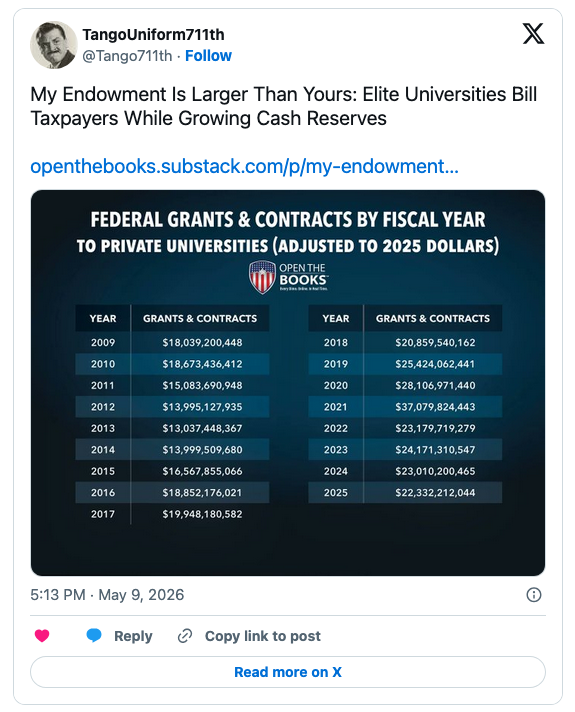
2025: $25 Billion Wasted on Universities
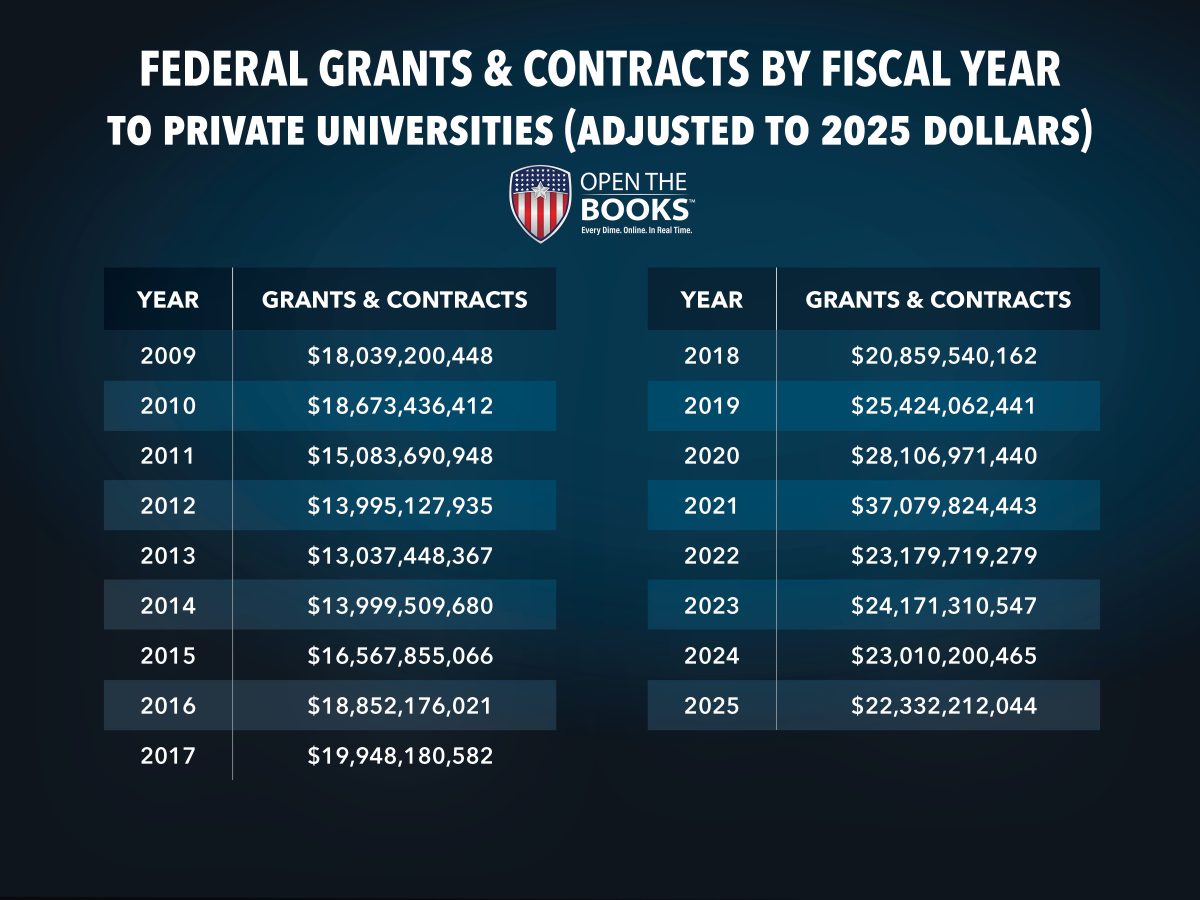
The seemingly good news in the OTB report is that private universities hauled in $22.3 billion in fiscal 2024, “the lowest amount since 2018, adjusted for inflation.”
But “Trump has yet to fully undo the spending spike that began during his first presidential term and continued during President Joe Biden’s administration,” OTB continued:
Private colleges receive 40% more federal research funding today than during an average year under President Barack Obama, even adjusted for inflation.
Some of the money helps fund weapons development, disease research, and more. It also forces taxpayers to spend tens of billions of dollars every year on overhead costs such as laptops and garbage collection.
OTB scrutinized 20 elite universities. It found “moderate correlation between per-student federal funding and per-student endowment growth.” The more tax money a university receives, the more of its own money it keeps on Wall Street:
Lavish federal funding and preferential tax treatment allows them to avoid dipping into their endowments on research and other costs of doing business.
The OTB review of the elite schools found that three of them — Johns Hopkins, the California Institute of Technology, and the Massachusetts Institute of Technology — have skinned the taxpayers for the most money “for years,” taking in some 30 percent of federal research money destined for schools. Indeed, OTB reported, the gross domestic product of 34 countries was less than Johns Hopkins’ haul of tax money last year.
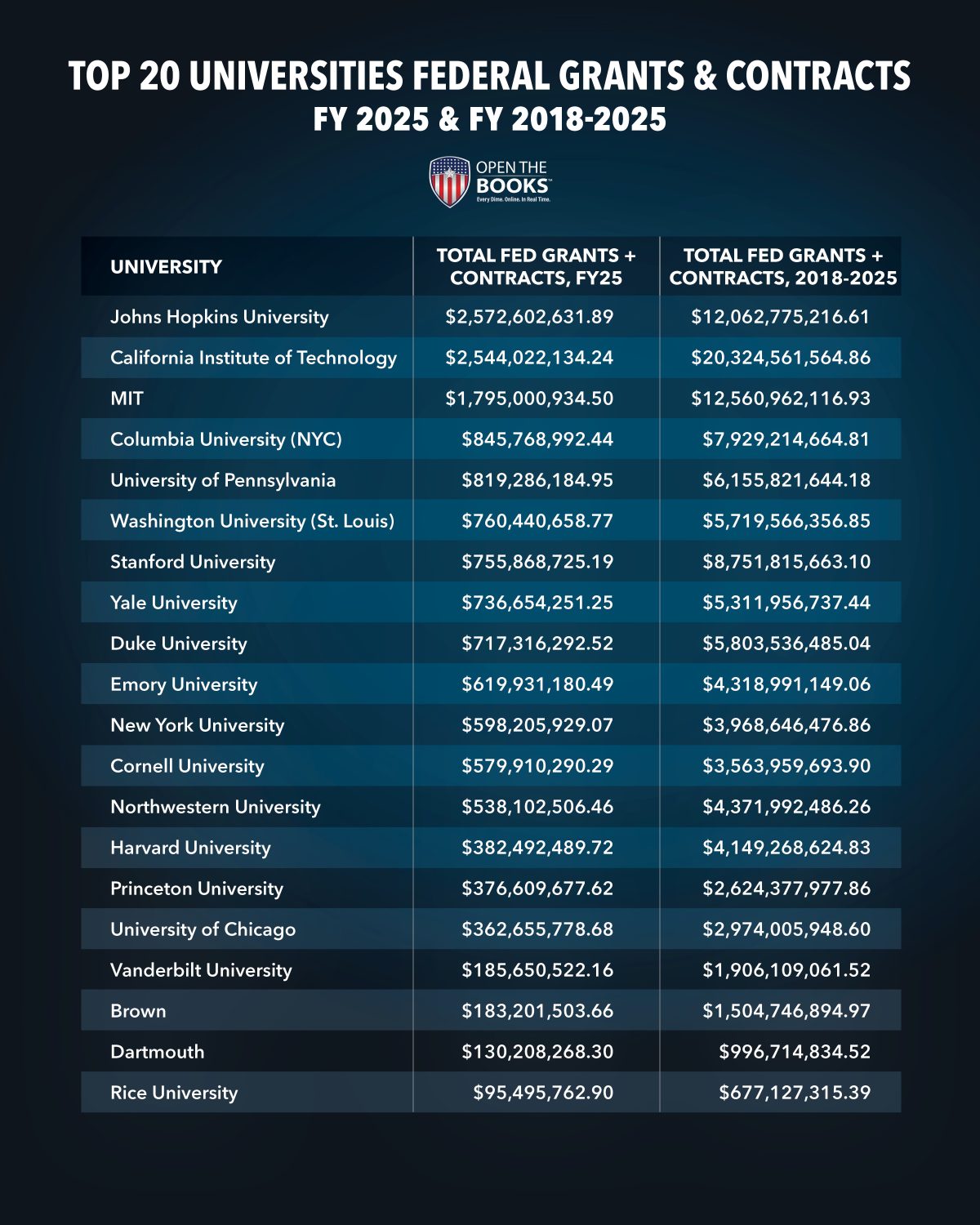
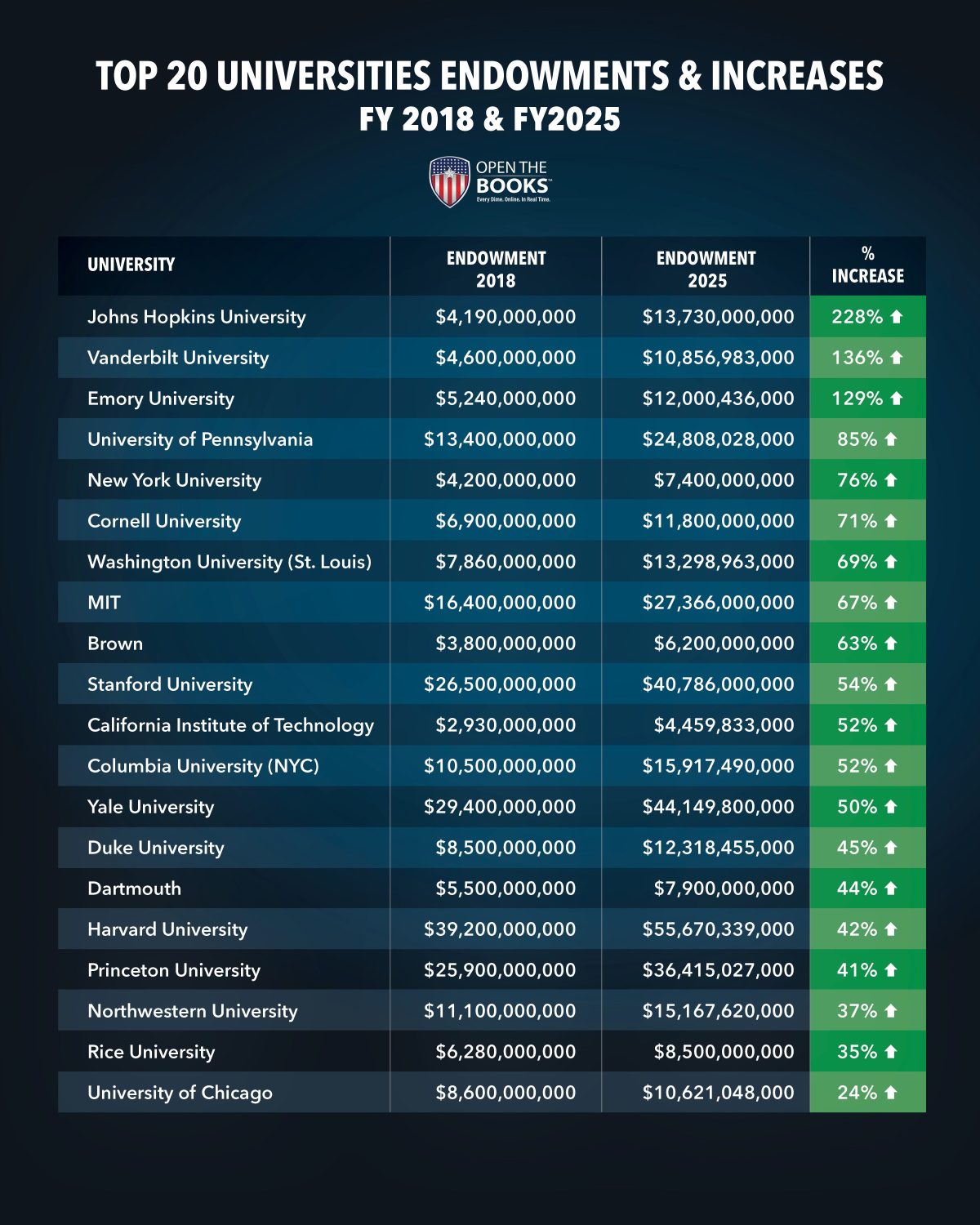
“From 2018 to 2025, these schools’ endowments grew by 70% on average,” OTB reported:
Endowments at Vanderbilt and Emory more than doubled. Johns Hopkins’ endowment more than tripled.
Endowment growth is primarily driven by private donations and investment returns. But there is also a moderately strong relationship between the 20 elite schools’ per-student federal funding and their per-student endowment growth from 2018 to 2025.
Tax-free Loot
For the universities, the free money is a great deal. They can duck spending their own money on research, which protects the money in endowments, and “those appreciating assets keep them among the richest institutions in the country even as they splash out for big administrative salaries, building upgrades, athletics, art galleries, and much more.”
What’s more, because the universities are “nonprofits,” they don’t pay taxes on the gains on their endowments.
Trump at least changed that … a little:
For years endowment growth was completely tax free, but Trump has successfully put some taxes in effect. The 2017 Tax Cuts and Jobs Act required private colleges with more than $500,000 of endowment assets per student to pay a 1.4% tax on realized gains. The One Big Beautiful Bill Act of 2025 increased the tax to 8% for schools whose endowments are worth more than $2 million per student (Currently, that applies to Princeton, Yale and Stanford.)
Such is the scam on the taxpayers that universities don’t pay for overhead connected to the federal grants. They get a “negotiated Facilities & Administrative rate with the federal government, typically ranging from 50-60%,” OTB reported:
That means for every $1 the government pays a school for direct scientific research, the school also gets 50 to 60 cents for overhead costs. Those expenses can include building construction and maintenance, water bills, janitors, accounting expenses, ethics and legal compliance expenses, Human Resources services, and even grant-writing costs. In a few cases, we’ve documented related wacky podcasts launched to complement research.
And when the National Institutes capped overhead rates at 15 percent, the greedy universities sued and received a permanent court injunction that blocked the cap.
“Congress also rejected Trump’s attempts to cap overhead rates,” OTB reported:
A budget resolution that passed 26-3 in the Senate Appropriations Committee barred the NIH from changing how it calculates overhead.
Stupid Research
Spending any more on these obscenely wealthy “nonprofits” is bad enough. But what they use the money for is worse. If they aren’t spending tax money on useless research, they’re spending it on junk science, OTB disclosed:
Columbia University: $745,323 to study “the nature of curiosity itself … and of its direct consequences.” The researchers will test their hypothesis that “curiosity promotes learning.” (most recent funding action: April 2025).
Harvard University: $2.5 million for “equitable and accessible research-based testing … to reduce the impacts of the warming climate on marginalized communities.” The study’s description explains that “climate change disproportionately affects individuals and communities that experience social and environmental vulnerabilities and discrimination.” (most recent funding action: March 2025) …
Cornell University: $5,500 to fund an open-access edition of Among Women Across Worlds: North Korea in the Global Cold War by Suzy Kim. The book uses a feminist perspective to evaluate how women “espousing communism” contributed to the spread of socialism and anti-colonialism as a method of liberation from patriarchy. (most recent funding action: February 2025)
Johns Hopkins University: $3.9 million for “characterizing intersecting sexual, gender, and race-based stigmas affecting communities of U.S. transgender women and cisgender men who are sexually active with men.” (most recent funding action: September 2025).
Duke University: $784,147 to build robots that mimic the movements of mantis shrimp. … (most recent funding action: February 2026).
Vanderbilt University: $115,696 for a project that “explores how developmental norms presumed to be generalizable are reproduced, challenged, and sometimes disrupted within scientific and activist communities.” … (most recent funding action April: 2025)
Big Endowments
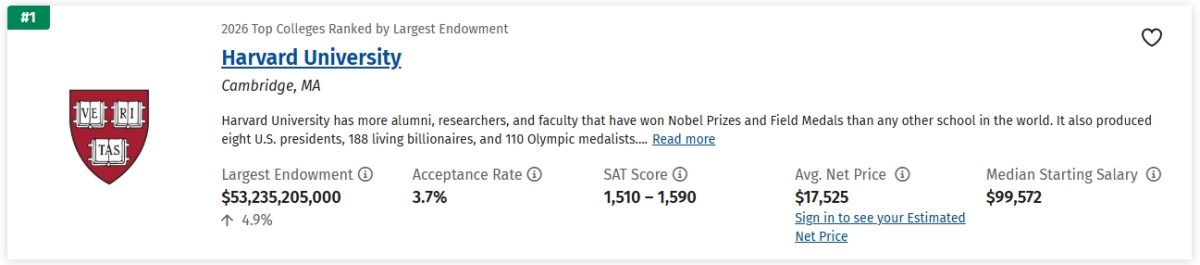
Taxpayers who want to know just how rich the universities can find out by visiting the College Raptor website. Its data for 2026 show the following endowment amounts for the top five:
Harvard: $53.2 billion
Yale: $41.4 billion
Stanford: $37.6 billion
Princeton: $33.4 billion
MIT: $24.6 billion
Harvard’s endowment is larger than the GDP of all but the world’s 99 richest countries. Yale tops all but 108 countries, and Stanford all but 113.