

Jason Arday Commits Suicide: Did DEI Kill the Fabulist Professor? Some Blame Its Critics.
Did diversity, equity, and inclusion (DEI) kill Jason Arday? Strictly speaking, Arday, 41, the academic who resigned August 5 from Cambridge University over plagiarism charges, died by apparent suicide. He was found deceased Friday at his property in Battersea, South London. But it’s hard escaping the conclusion that had he not been DEI-enabled by Cambridge, he’d be alive today.
I’d reported on Arday twice recently, and I was shocked upon hearing late last night of his passing. Condolences should be extended to his loved ones; his is a sad and tragic story. It’s important, however, to learn the right lessons from it. And as of now, it’s apparent that some would bury the Truth with Arday.
A Foundation of Sand
To be clear, the academic career of Arday — Cambridge’s “youngest black professor” — was a house of cards. It was only a matter of time before it came tumbling down. As New York’s The Sun put it last week, if “the Onion or Babylon Bee” aimed to spoof DEI, its story wouldn’t have been as unbelievable as Arday’s.
Yet Cambridge did believe it — or pretended to — until it could pretend no longer.
Credible evidence emerged that Arday had plagiarized more than 100 passages in his doctoral thesis. Yet the university still believed him — or pretended to.
He claimed he’d run 30 marathons in 35 days (with a fractured leg and after having an epileptic seizure). Cambridge believed him — or pretended to.
Arday said he couldn’t speak until age 11 (former classmates revealed this as fiction). Cambridge believed him — or pretended to.
That’s just the tip of the iceberg, too. It was clear to anyone with eyes and ears that Arday was a George Santos2-proportions fabulist. Yet Cambridge believed him — or pretended to.
Memory-hole Efforts
And some still want to believe the fiction. For example, People magazine, channeling Pravda, just published an article replete with lines such as:
After his death, Arday’s family said in a statement … that he “was subjected to a campaign of sustained abuse for the more than three years since he accepted the role of Professor at Cambridge University by those who would leave no stone unturned in their quest to undermine him.”
Reading the piece, you’d think the academic was railroaded. The comments section is no better, as respondents appear oblivious to the real story. (In fairness, the co-authors may be as well; many journalists are woefully un- and mis-informed.)
Worse still, activist Shola Mos-Shogbamimu wrote yesterday on X, “This is a public execution. You hounded Jason Arday to death. You murdered him. You killed him.”
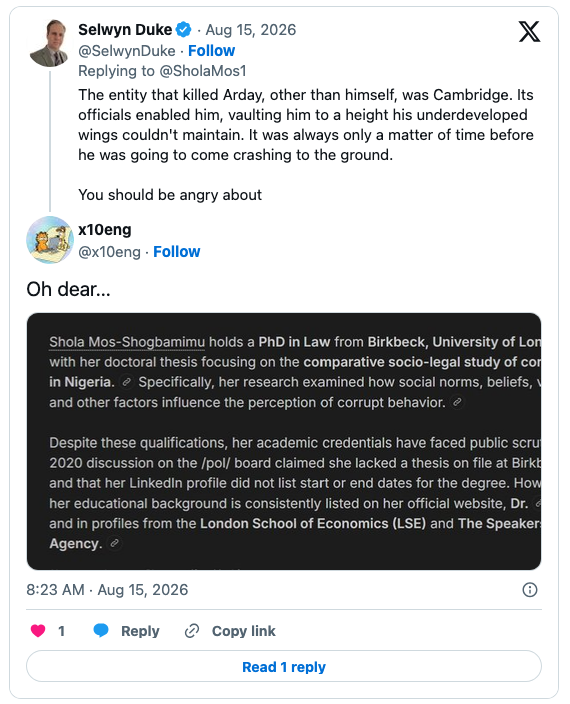
(Perhaps not surprisingly, the legitimacy of Mos-Shogbamimu’s own Ph.D. is also in doubt.)
Yet as I wrote on X this morning, responding to Mos-Shogbamimu:
The entity that killed Arday, other than himself, was Cambridge. Its officials enabled him, vaulting him to a height his underdeveloped wings couldn’t maintain. It was always only a matter of time before he was going to come crashing to the ground.
You should be angry about DEI. If academia had never enabled Arday, he’d almost certainly be alive today. Remember: The onus never belongs on the people who reveal the Truth; it belongs on those who enable a lie.
This point brings to mind the “academic mismatch” phenomenon the late Professor Walter E. Williams once bemoaned. Inserting middling-performing black students into elite schools they can’t handle, he warned, is often disastrous. Instead of studying in a less rigorous institution they can qualify for, and graduating, they may end up flunking out. This can sometimes kill their academic and career prospects.
Cambridge made Arday the ultimate academic mismatch — and it killed him.
And now the kind of people who helped construct this academic illusion are blaming those of us who shone the light of Truth on it. The implication is that we should let DEI delusions and fabrications slide; we should advance the lie. Of course, this would be very convenient for the civilization-destroying social engineers.
The issue, however, is that Cambridge compounded its sins. After hiring Arday without proper vetting, it refused to hold him accountable without intense pressure being applied. Only a campaign by media, and other Cambridge academics, spurred it to action.
“Lies Have Short Legs”
So it should be clear that little of this is about the unfortunate Mr. Arday. Most of us have met people like him (some have what the headshrinkers call Narcissistic Personality Disorder). Why, I have a neighbor thus disposed. As he tells it, he has been an actor, among other things. During Covid, he claimed he once worked with Anthony Fauci. Just yesterday he said he didn’t have diabetes because he’s the same weight as in high school (perhaps true). Then, implying he ought to know, he added that he’s a doctor (he’s not).
Such people obviously have a serious problem. But what’s Cambridge’s excuse?
What excuse does the entirety of academia — and all our pseudo-elite institutions — have? All these entities have embraced the DEI fiction (and so many others). They lie to their civilizations and to themselves pathologically.
And now Arday’s passing gives Cambridge an excuse to bury its troubles with him. It can halt its investigation into the academic, pay its crocodile-tear tributes, and move on.
As to the moral of this story, my mother would sometimes say, “Lies have short legs.” That our “elite” institutions are actually pseudo-elite and don’t grasp this is tragic. After all, troubled individuals will always be with us. But troubled institutions that enable them are a sign of a civilization in steep decline.