

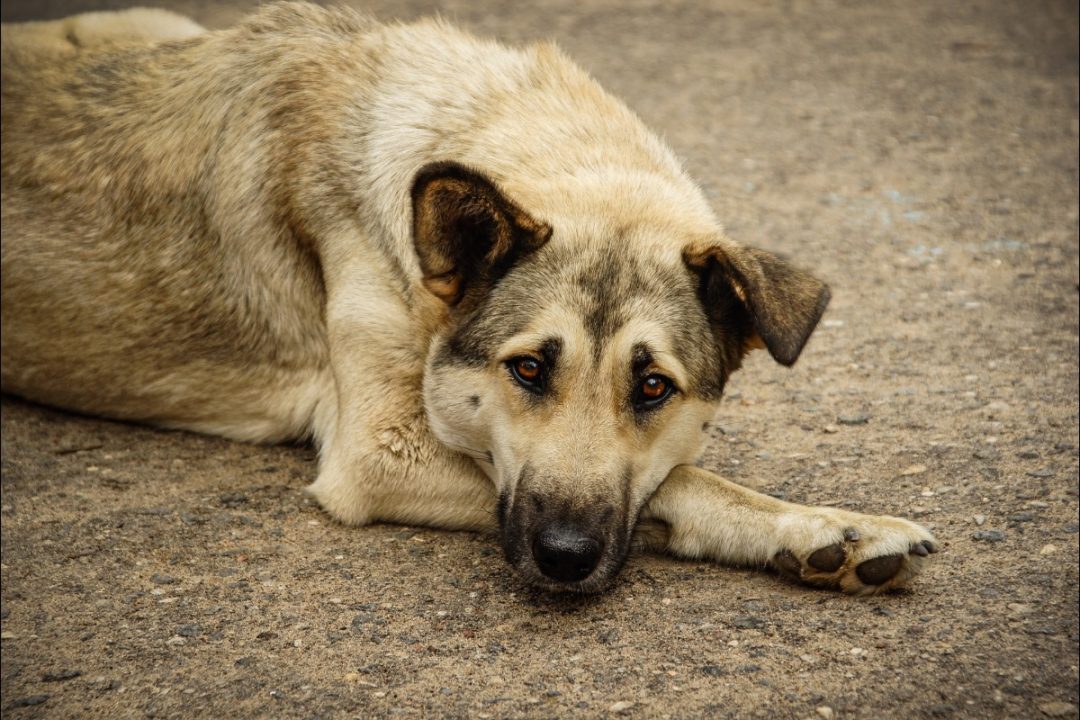
Diversity’s Fruits: Islam’s Brutal War on Dogs Comes to the U.S.
“The dog is man’s best friend” the saying goes. Why, we humans argue about most everything, notes website History and Headlines. “If there is one thing most people agree on, though, it is dogs,” it continues. “How can you not love them?”
Maybe one Nerdeen Kiswani can answer that question. After all, Kiswani, a Palestinian activist, recently agitated against the American norm of keeping dogs as indoor pets.
As she put it in a tweet last Thursday, “Finally, NYC is coming to Islam. Dogs definitely have a place in society, just not as indoor pets. Like we’ve said all along, they are unclean.”
After pushback, Kiswani attacked her critics. “Lmao at the Zionists frothing at the mouth at this…,” she wrote. “It’s obviously a joke.”
Many noted that it’s obviously not. Regardless, no one is laughing — especially given Islam’s history of condemning, abusing, and even torturing dogs. (More on that momentarily.)
Notable pushback came from Congressman Randy Fine (R-Fla.) who, among other things, tweeted the following. (Kiswani’s original message is below Fine’s.)

Predictably, many condemned Fine as not so fine and demanded he resign. (To his credit, he didn’t back down but doubled down.) Many took issue with his implication that Kiswani’s sentiments are general Muslim ones. The truth, however, is this: As Islam comes to the West, so does its war on dogs.
The Prejudice Is Against Canines, Not Muslims
Commentator Andrea Widburg addressed this Wednesday, writing:
Muslims look to their faith to justify hating dogs. No wonder, then, that the dog war has finally come to America. And while Americans are willing to tolerate many insults from Islam, it remains to be seen whether they will tolerate Islam’s murderous intent toward man’s best friend.
The Muslim war on dogs is nothing new. While there is a trend in Islamic countries towards laws protecting animals, the fact remains that, across the Islamic world, the Muslim street doesn’t just want fewer dogs. It has a culture that encourages exceptional cruelty toward dogs. Torturing dogs is as much a part of childhood culture in large parts of the Muslim world as cuddling dogs is in the Western world.
As an example, consider the following shocking 2019 story from The Independent:
The US has stopped exporting bomb-sniffing dogs to Egypt and Jordan after a number of animals died from mistreatment and neglect….
The decision, which is temporary, follows a US report released in September highlighting cases of negligence of dogs sent to Jordan, Egypt, and eight other countries.
Sniffer dogs are part of the Antiterrorism Assistance Explosive Detection Canine Program, which was established by the US government in 1983 to provide training and supplies to foreign law enforcement personnel.
… The September report … detailed unacceptable conditions in Jordan and included photographs of emaciated dogs and faeces-covered floors in kennels.
A follow-up report earlier this month found two dogs had died in Jordan of heat stroke and insecticide poisoning respectively.
… It also found three out of 10 dogs sent to Egypt in August 2018 have died, but Egyptian authorities have not allowed US personnel to access the dogs or their kennels….
While the brutality here is bad enough, there’s more to it. We were kind enough to let the people in question use our bomb-sniffing dogs. The canines’ training does, too, cost up to $150,000 per animal. And this is how these people treat valuable dogs who can save their lives.
How will they treat dogs who don’t serve a “practical purpose”?
We needn’t wonder. Widburg provides the following tweet, for example.
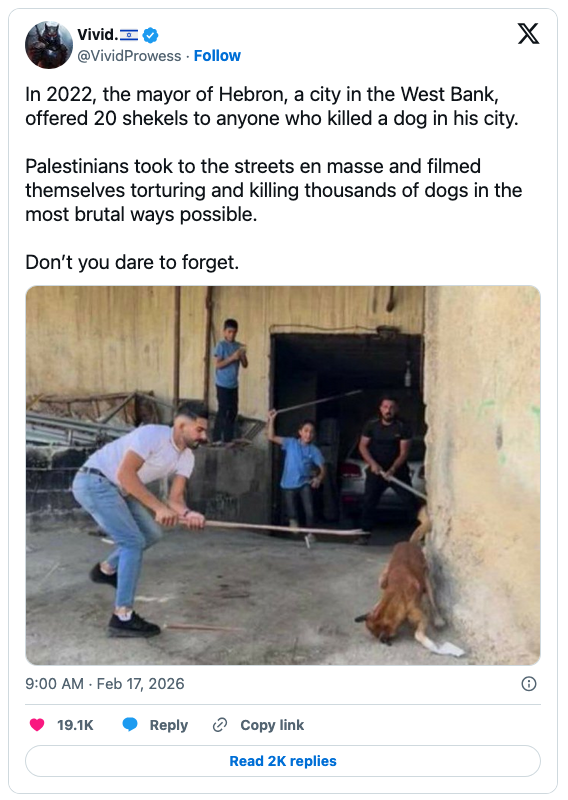
She then mentions how Morocco plans to massacre three million dogs in preparation for hosting the 2030 World Cup. This isn’t some merciful euthanization program, either. As the Daily Mail reported Tuesday:
Animal welfare organizations have released images and testimony alleging Moroccan authorities are using harsh methods, including clamping dogs by the neck, loading them into trucks and poisoning or shooting them before disposing of their bodies in mass graves.
… Witnesses in … host cities alleged that dogs were starved for days before being burned alive at rubbish depots.
A relevant video follows.
Note that the most telling videos, a couple of which I embedded in an article years ago, I can no longer find. YouTube apparently removed them for being too graphic (and too revealing and politically incorrect?) But know this: Acts such as injecting dogs with acid are not unheard of in the Islamic world.
Whence the Wickedness?
Now, to some extent, Muslims’ canine abuse reflects the harsher treatment of animals generally witnessed in the non-Western world. I’ve seen this myself, having visited that world, and China can treat dogs harshly, too. Yet Muslims are also influenced in this by what they consider divine injunction.
As Islam expert Robert Spencer points out, it’s not just the Muslim canon’s statement that angels “do not enter a house which contains a picture or a dog.” It’s that Muhammad himself — whom Muslims consider “the Perfect Man” — ordered their killing. As Spencer writes, quoting the hadiths (which purportedly record Muhammad’s life):
Allah’s Messenger (may peace be upon him) ordered the killing of dogs and we would send (men) in Medina and its corners and we did not spare any dog that we did not kill…. — Sahih Muslim 3811
… Ibn Mughaffal reported: The Messenger of Allah (may peace be upon him) ordered killing of the dogs…. — Sahih Muslim 551
Only dogs used for hunting or guarding herds could possibly be spared, too.
Spencer also promulgates an interesting theory. He mentions that the hadiths forbade pictures likely to further distinguish Muslims from non-Muslims. After all, Christians cherished images and other representations of Jesus, Mary, and various saints. So the idea, stated Spencer, was to forbid what Christians encourage. It was part of an effort to crush a competing faith.
It was perhaps likewise with dogs, asserts Spencer. The target here would’ve been Zoroastrians, whom Arab Muslims had conquered in Persia — and who revered dogs, considering them “clean.” So the hadiths labeled them “unclean” and provided another motivation to extinguish a competing faith.
Man’s Best Friend
When pondering this, though, I think of the time a friend and I pulled over on a North Maine Woods logging road. While tending to some task, we noticed a pair of little eyes peering at us amidst a bush. It was a young canine, and there he stayed, for some minutes, observing us curiously. (It might’ve been his first time seeing humans.) It’s certain, too, that prehistoric man also made such a connection with canines and realized, “This is a special animal.” And since then, for 15,000-20,000 years, man has been domesticating dogs and making them all the more special.
Moreover, speaking volumes about a civilization is how it treats its weakest, whether people or animals. All animals are “weak,” too, in the sense that with man’s great intelligence, they’re at our mercy.
Consider as well the all-too-normalized torturing of dogs (and other animals) by children in some Muslim cultures. Is such conditioning not worrisome? After all, many serial killers get their start with torturing and killing animals.
Now, too, maybe we know why Christianity provides Francis of Assisi’s example of love toward animals. And maybe we should also ponder who might most want to cultivate hatred for all of God’s creation, man and beast.