

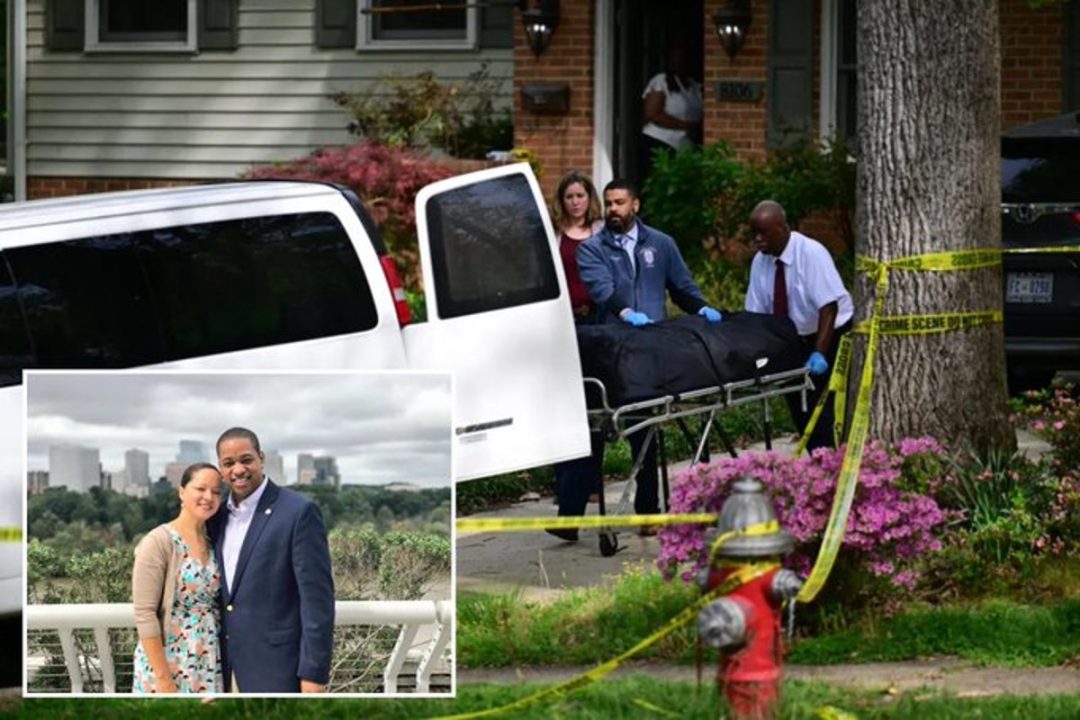
Former Va. Lt. Gov. Murders Wife, Commits Suicide
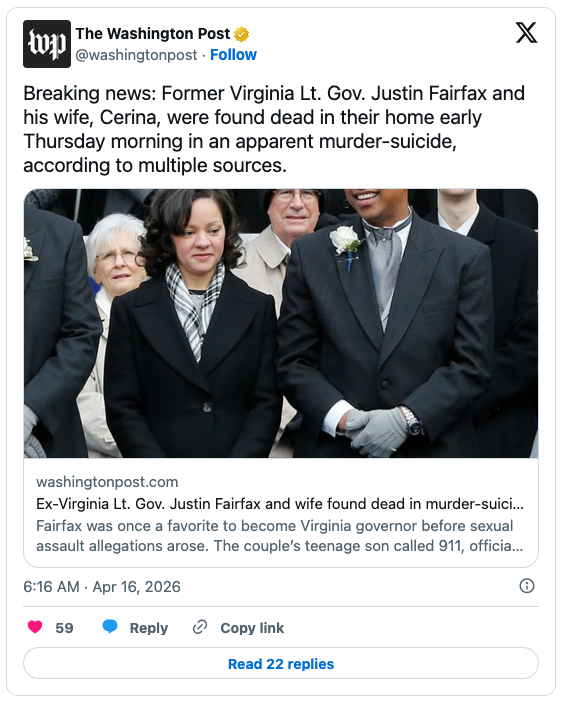
Former Virginia Lieutenant Governor Justin Fairfax, whose rise to the state’s highest office was stopped cold by two accusations of sexual assault in 2019, murdered his wife and shot himself last night.
Fairfax County cops found the 47-year-old lawyer and his wife, Cerina, dead after one of their kids, who were in the home when Fairfax committed the murder-suicide, called 911.
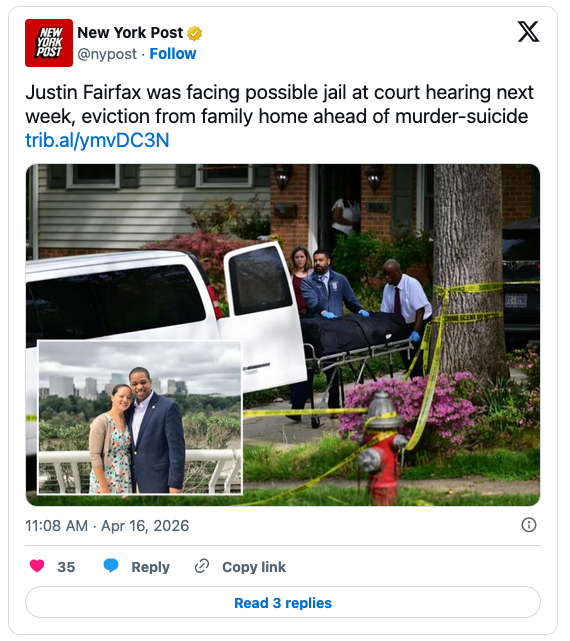
County Police Chief Kevin Davis said the two were heading through a “messy” divorce and that Fairfax had just been served paperwork. That paperwork, the New York Post reported, included a threat that Fairfax would be jailed if he didn’t pay court-ordered expenses to Cerina. The two were separated but still lived together, and Fairfax had been ordered to leave the property by April 30.
The attorney for a woman who alleged sexual assault by Fairfax told the Post that “signs” of his anger had been going on for decades.
Forthcoming Court Proceedings
During a news conference this morning, Davis did not offer much detail about the murder-suicide except to note the upcoming court proceedings, say that the kids were the No. 1 priority for officials, and say that Fairfax lodged a false accusation of physical abuse against his wife.
“This has been an ongoing domestic dispute surrounding what seems to be a complicated or messy divorce,” Davis said:
So far what we know is probably what you all know, and I don’t think it’s a secret that there’s been divorce proceedings that have been ongoing. From what I understand at this early stage … Fairfax was recently served some paperwork associated with an upcoming court proceeding that apparently led to this incident last night.
The couple’s teenage children, a son and daughter, were in the house when Fairfax committed uxoricide and suicide.
“So that’s horrible news for the family,” Davis continued, and “a traumatic event for those children to live through.
Davis said the once-slated-for-greatness Democratic star shot his wife in the basement. Then he ran upstairs into the master bedroom to shoot and kill himself.
The couple lived in a $910,000 home in Annandale. Fairfax faced a three-day hearing next week, the Post reported, that would settle assets division.
“Cerina filed a motion on April 3 to hold Justin in contempt for allegedly missing a court-ordered March 25 deadline to pay her $1,865 toward household expenses,” the Post reported:
Cerina’s papers said the judge should consider throwing Justin behind bars until he paid her what he owed.
“You may be found in Contempt of Court for your failure to abide by the terms of this Court’s Orders,” said the papers filed by Cerina’s lawyer Amy Spain. “The potential punishment may include, but is not limited to, your imprisonment until you come into compliance with this Court’s Orders or present a reasonable plan to do so.”
The wife wanted her newest contempt motion to be addressed at next week’s hearing.
On March 30, Judge Timothy McEvoy issued a blistering ruling laying out Cerina’s claims that Justin was drinking, smoking and reclusive in their home and nearly completely absent from the lives of their kids — Carys, 14, and Cameron, 16.
McEvoy ordered Justin to move out of the house by April 30 and cut his visitation with the kids down to a few hours on Wednesdays and Saturdays. The judge also ordered Justin to take alcohol tests an hour before he saw the kids.
McEvoy attributed Justin’s mental health decline to two pivotal moments, his failure to win the Virginia attorney general’s race in 2013, and when sexual assault allegations surfaced against him by two women in 2019.
Phony Assault Allegation
In January, Davis said, Fairfax called cops to allege that wife Cerina assaulted him. The ploy to get his wife in trouble failed because she had installed cameras in the home. Cops went to the house, reviewed the cameras’ footage, and “corroborated that the alleged assault never occurred.”
Cops did not charge Fairfax for filing a false report.
“One of the children was the 911 caller just after midnight” Wednesday, Davis said, and “described some things to us … that we’ve since corroborated.”
Davis said he didn’t know anything about the gun except that Fairfax used the same firearm to murder his wife and kill himself. Davis also revealed that “there wasn’t a pause” between the murder and suicide. “There was never a moment where someone was holed up in a room or cops were here and it was … it all happened pretty spontaneously.”
Political Rise
Fairfax was a top-flight lawyer and former federal prosecutor when he entered politics; his wife, 49 at the time he murdered her, was a successful dentist. The Democratic power couple met as undergraduates at Duke University. He graduated from Columbia University law school, while she graduated from Virginia Commonwealth University dental school.
Fairfax’s political career before elective politics included working for Tipper Gore during Vice President Al Gore’s failed presidential campaign, and working as a staff member for former Virginia Senator John Edwards. When former Senator John Kerry of Massachusetts ran for president, Fairfax became running-mate Edwards’ body man.
After losing a primary for Virginia attorney general, he won a primary for lieutenant governor, then served in that post under Governor Ralph Northam. Northam was nearly forced from office when photos of him in blackface during college surfaced. Northam also famously advocated infanticide, and favored removing the priceless equestrian statue of Robert E. Lee in Richmond after permitting leftist Floyd Hoax rioters to vandalize it.
Fairfax was poised to possibly succeed Northam until two women accused him sexual assault.
Allegations of Sexual Assault
As The New American reported in 2019, Vanessa Tyson, a professor at Scripps College in California, said Fairfax forced her to perform a sexual act during the Democratic National Convention in 2004. Her story first surfaced on the conservative Big League Politics website.
The two met, she wrote in a statement for the media, on July 26, 2004:
On the afternoon of the third day of the Convention, July 28, 2004, Mr. Fairfax suggested that I get some fresh air by accompanying him on a quick errand to retrieve documents from his room in a nearby hotel.
Tyson said that the few interactions she had had with Fairfax gave her “no reason to feel threatened,” and so she agreed to head to his room. That’s when Fairfax, she wrote, made his move. He began kissing Tyson, and “although surprised by his advance, it was not unwelcome and I kissed him back. He then took my hand and pulled me towards the bed.”
Fairfax forced her to perform oral sex on him, she alleged.
A second accuser was Meredith Watson. “It was her sophomore year at Duke and his senior year, and they were hanging out,” her attorney, Nancy Erika Smith, told The New York Times:
They had never dated. She had dated one of his friends. They did not have a romantic relationship. He gets up and walks out. Comes back in. Shuts off the light and locks the door. She knew things were going south when he locked the door.
A friend of Watson’s, Kaneedreck Adams, told The Washington Post and the Times that Watson accused Fairfax when they were in college. “She told me she had been raped, and she named Justin,” Adams told the Post:
“She said she couldn’t speak, but she was trying to get up and he kept pushing her down,” Adams said. “She said he knew that she didn’t like what was happening, but he kept pushing her down.”
Fairfax called the accusations a “lynching” and refused to resign his post. He served out his term, and nothing came of the allegations.
After the murder-suicide last night, Watson’s attorney strongly suggested that Fairfax was a time bomb waiting to explode.
“There were decades of signs of his anger and mistreatment of women and he used the court system to intimidate his victims and news outlets,” Smith told the New York Post.