
The Death of Political Debate in the Modern World
Consider, for a moment, the dry Mediterranean sun bearing down upon the people of fifth-century Athens. In the crowded agora, a young man pauses to observe a heated exchange between a gray-haired, portly old man and a prominent politician. There is no stage, no podium, and no deliberately assembled audience. The crowd around them shifts continuously. Periodically it moves between congestion and the scant, intermittent flow of merchants. If one were to stand too far away, the random sounds and chatter would drown out the debating men. Despite this hectic environment, the attention of the two men remains fixed on one another. Their objective is clear: It is not to seek the applause of an audience, but the pursuit of something far more consequential.
Unbeknownst to the young man, the weathered gentleman before him is Socrates, who would become one of the most influential and widely recognized philosophers in Western history. His method of questioning the politician is not overly performative, nor aggressive. Rather, each question methodically strips away the pretensions shaping his interlocutor’s position. It becomes obvious how the politician would eventually need to confront the logical consequences of his own beliefs. Through this process of inquiry, Socrates turns an ordinary conversation into a rigorous and skillful examination exposing the problems with the politician’s beliefs.
The Socratic method was developed to uncover truth through the dialectical process of questioning during open dialogue. It was originally a philosophical protest against the tradition of the Sophists, who were known to value the persuasion and influence of rhetoric over critical inquiry. Plato first articulated the method in his dialogues, namely Apology, Euthyphro, and Meno, from which it was developed by subsequent generations of philosophers.
Given the profound influence and accessibility of the Socratic method, how, then, did we arrive at our present situation of modern debate?
The World of Modern Debate
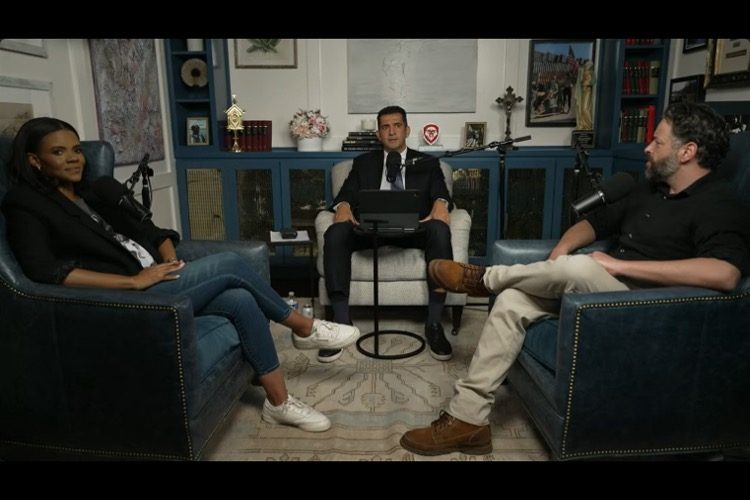
On August 14, 2026, conservative podcaster Candace Owens and online debater and content creator Andrew Wilson engaged in a highly publicized debate concerning the circumstances surrounding Charlie Kirk’s murder. According to Owens, in the less than 24 hours following the livestream, the debate captured more than three million views. On other platforms, such as Wilson’s or Patrick Bet-David’s (who previously agreed to moderate the debate), the views are also growing.
It is difficult to overstate the cultural impact of this debate. For almost a year after the Charlie Kirk assassination, Owens has fully constructed her own account of the event in order to challenge the official narrative. With her team of private investigators, she has managed to develop a story attracting millions of followers to her platform, further drawing widespread attention to her personal mission to know who killed Charlie. Over the past year, it has been increasingly difficult to ignore her impact online. Similarly, those defending the official narrative corroborated by the findings of the FBI and eyewitness testimony claim that Owens’ rhetoric is proving itself to be damaging to the pending legal case and overall cohesion of the conservative movement in America. This prompted Wilson to publicly challenge Owens during his recent appearance on Joe Rogan’s The Joe Rogan Experience podcast, announcing that he offered her hundreds of thousands of dollars to openly debate her.
Setting aside the sensationalism of the topic, many expected Wilson to conduct a rigorous examination on Owens’ findings, hopefully challenging the assumptions underlying her conclusions. Onlookers anticipated Wilson to expose fractures in Owens’ claims, while others were confident Owens would successfully defend her position and prove that her findings were coherent and credible.
The truth of the matter is that, once it was all over, neither won the debate.
The so-called “Superbowl of Charlie murder content,” as described by The Daily Wire pundit Michael Knowles, the debate proved to be less of an exercise in precise deliberation and more of a lackluster performance of competing podcasters. Andrew Wilson, who sells courses online on how to debate under the name “Debate University,” failed to fully contend with Owens’ claims and allowed his opponent to talk over him multiple times. Owens herself failed to remember basic facts of the case.
Even though the Candace Owens-Andrew Wilson debate on Charlie Kirk’s death was lacking in substantive delivery, or even the “star power” performance everyone expected, such exchanges are far from uncommon in contemporary political discourse.
The fact is, most debate lacks substantive delivery now. Modern debate has been shaped by the demands of online media and the oversaturated attention economy. Platforms with massive audiences, such as the popular YouTube channel Jubilee, have popularized a style of debate that is wholly confrontational, highly produced, and overly dramatic, primarily through its webseries known as Surrounded. In a recent episode of Surrounded, well-known podcaster Tim Pool storms out from a debate during a confrontation with a young adult after a frustrating series of questions. This single moment has been clipped by the show and hundreds of others on X, where it has generated millions of views across multiple platforms. Note that it was really not the overall discussion leading up to this moment, nor even the debate question itself that prompted the views and online conversation, but simply the scene of Pool’s ill-tempered exit itself.
The substance of the clip may seem intellectually vacuous, but it is just provocative enough to attract millions of views, shares, followers, and channel subscribers to the original page. Platforms such as Jubilee might have seemingly popularized political and religious debate, but it is not done in the format that we are historically used to. Although the channel posts the full episodes to its primary channel, it is primarily motivated by the efficient production of highly shareable clips of exchanges that only run seconds long, where it usually includes an inflammatory political statement, an embarrassing moment, or just pure chaos.
In another viral clip of Surrounded, a young man asks author and media commentator Jordan Peterson his opinion on the Immaculate Conception following Peterson’s public statement on attending a Catholic church. Before Peterson could provide a coherent answer, the young man strikes with another question, this time asking Peterson if he is indeed a Christian. In that moment, Peterson appears taken aback, but still quickly tries to articulate a clear response in an effort to keep the conversation going. He is unable to offer a simple “yes,” prompting his interlocutor to seize upon the hesitation, not to examine why Peterson struggles to answer, but instead to characterize him as a liar and calls him “a whole lot of nothing.” The clip is hardly minutes long, but has essentially branded the entire episode as Peterson’s failure to acknowledge his developing faith. Hundreds, even thousands, of comments flooded the video on multiple platforms, attempting to humiliate Peterson for a simple misstep in his delivery. It only took a few seconds for him to publicly discredit his image.
Rather than encouraging participants to develop complex arguments, such formats cultivate a culture that is centered on intense confrontation, public humiliation, and sophistry. The shareable clips and videos that are produced document purely rhetorical victory. The substance of the debate is therefore no longer confined to the people in the room, nor even to the audience watching the entire program from home; it is simultaneously being produced for the 30-second clip where a minute-long exchange reaches millions of viewers, and makes or breaks one’s public image, and even career.
This approach to producing debate, fully driven by the science of audience retention, has created an incentive for political figures, influencers, and commentators to approach debate less as an exercise in analysis, or even creative persuasion, and more as an opportunity to generate content and gain short-lived relevancy. In our modern political culture, a participant gains more from delivering a memorable line or embarrassing an opponent than from carefully understanding and explaining a complex policy or ideological position.
Ultimately, the result is a political world increasingly concerned with appearing to win rather than demonstrating logical consistency or effective persuasion. Much of this is the result of the attention deficit many are experiencing due to the push for more short-form content, such as those found on TikTok, Instagram, or YouTube Shorts. No longer can one simply sit down to listen to a full debate without quickly losing interest. The craft of debate is dying and is being replaced by ideological brawls where no conclusion, agreement, or synthesis of ideas can be accomplished. This is fixed on the fact that sustained reasoning is difficult to translate into viral content. Channels such as Jubilee are representative of a broader transformation in political communication, which is that debate is no longer a contest of ideas, but a form of cheap and easy entertainment. Every argument is potentially being performed for the clip that will survive long after the debate itself is forgotten.
The Future?
Even though many have felt that the Candace Owens-Andrew Wilson debate was lacking in excitement and substance, they fail to recognize that it was because the subject itself was not conducive to a “viral moment.” Expounding the details of a very complicated and morbid case such as the Charlie Kirk assassination is a difficult process. It requires some degree of tact, and does not lend itself to shareable, “meme-worthy” moments.
The future of political debate looks dismal, and its seriousness may be gone, but perhaps only for now. Online fatigue is a growing phenomenon shared among the ascending generation where the trend of “leaving the screen” is happening en masse. In other words, younger people want a break from mass-produced online content (many call it “slop”) and yearn for genuine connection, community, and meaning. It is impossible to envision a future wholly without social media, and the movement has not actually removed itself from using these platforms altogether, but only to a limited degree in an effort to “detox” from the effects of sustained exposure, whether that be physical or emotional. Rather, this movement is a direct protest against the meaning and substance (or lack thereof) or the attention-grabbing and provocative content Generations Z and Alpha are so used to seeing. This collective, silent protest is walking in the footsteps of one great philosopher who saw through the shroud of deception of the Sophists, so very long ago.