

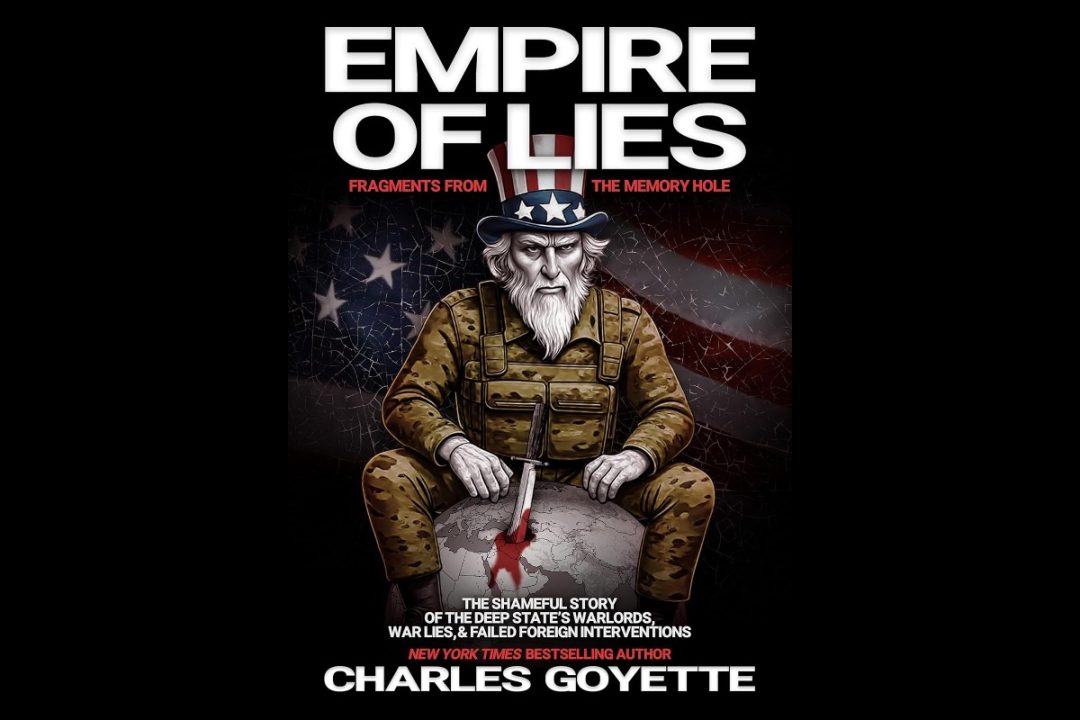
Empire of Lies — What Becomes of a Nation That Learns to Live on Fiction?
Charles Goyette’s Empire of Lies: Fragments from the Memory Hole arrived at an uncanny moment. For months, Americans were told that the military buildup around Venezuela and extrajudicial strikes on its vessels were all about stopping drug trafficking. President Donald Trump added ominous warnings that the country was “emptying its mental institutions” into the United States. Diplomats — whose job is supposed to be normalization and negotiation — leaned instead into escalation, quoting human-rights violations by the Nicolás Maduro regime and his daring to have relations with other nations, while brushing aside accusations that Washington was pursuing regime change.
Then came 2026, and the pretense was dropped.
Following Maduro’s abduction on January 3 — an operation that left dozens of people dead — President Trump said the quiet part out loud. “We’re gonna take back the oil that frankly we should have taken back a long time ago,” he told reporters. He then made clear that what lay ahead was not a brief intervention, but a long-term U.S. occupation, declaring, “We’re going to run the country until such time as we can do a safe, proper and judicious transition.”
The candor was, in many ways, another slap in the face to voters who expected Trump to rein in foreign entanglements. And yet, instead of confronting the betrayal, prominent right-wing influencers rushed to explain it away — the same voices who only yesterday condemned interventionism and hailed Trump as a “peace president.” Their answer was to dust off the Monroe Doctrine and dress it up as sober statesmanship: “Our hemisphere, our rules.”
The public, meanwhile, is supposed to forget the accusations of “narcoterrorism” as the Department of Justice (DOJ) quietly dropped a claim about Maduro’s alleged cartel involvement. Forget the humanitarian talk. The real motive had finally been spelled out loud and clear, and hardly anyone in power appeared bothered in the slightest.
In the meantime, the focus shifts, and new lies about other countries are offered as pretext for yet more interventions. Iran poses a threat. So do Cuba, Mexico, and Canada. Greenland should be taken — by force, if necessary.
At times, the White House appears fatigued by the need to even articulate a compelling rationale. Asked why Iran should be attacked if its nuclear facilities had already been “obliterated” by previous U.S. strikes, press secretary Karoline Leavitt offered only that “there are many reasons and arguments that one could make for a strike against Iran,” without naming one.
So, at what point does the justification for unilateral aggression stop mattering, and only the intervention remain?
And this is precisely where Goyette’s book becomes essential reading.
Because Empire of Lies is not just about individual interventions and their imminent failures. While the book is replete with familiar faces from both the Republican and Democratic parties, it is about the machinery that makes deception routine. Goyette describes the posture of perpetual intervention as America’s “full-time occupation” that requires compelling stories. Ordinary Americans have grown weary of foreign adventures. They feel the costs: massive drains on the treasury, inflationary pressures, and the erosion of liberty at home through emergency powers, surveillance, and measures like the Patriot Act. They see the human reality, too — millions of civilians killed or displaced in faraway lands, and the radicalization of survivors who experience American power not as liberation, but as despicable brutality.
No one could sell that picture honestly. So, Goyette argues, something else is sold instead.
He shows, for example, how the trauma of 9/11, rather than prompting restraint, was harnessed to justify conflicts that had little to do with the original attack. As part of that larger story, he revisits Iraq’s nonexistent “weapons of mass destruction” — the most notorious modern case of a public marched into war on a false premise, and one that the architects of the invasion later joked about with shameless brazenness. Even uncomfortable questions about the role of supposed allies, such as Saudi Arabia, were quietly brushed aside, because the narrative required simplicity, not nuance.
Go back further, and you find the Bay of Pigs — another moment when interventionism collided with reality, and when unresolved tensions about who truly directs American power began to surface.
Goyette does not write as a partisan. He shows a system that transcends parties. For instance, Barack Obama rode a promise in 2008 to wind down the Iraq War, only to have America stay engaged long after the campaign rhetoric faded. Likewise, Trump ran as a critic of “forever wars,” but once in office discovered that the machine he inherited was easier to use than dismantle. The “Deep State’s warlords,” in Goyette’s telling, are not shadowy villains so much as institutional forces that continuously push toward planetary projection of power — to the detriment of both the world and the United States itself.
If the war machine is the engine, the press is the gearbox. One of the book’s sharpest themes is the role of media in laundering official narratives. Instead of adversarial watchdogs, most of the outlets behave like faithful stenographers. Debate gets confined to tactics and execution. Questioning the premise becomes fringe, unserious, or unpatriotic. Sometimes the propaganda is crude and collapses quickly. Other times it is sophisticated, built on anonymous officials, classified briefings, and assurances that cannot be independently verified. Either way, the effect is the same. A public that would resist intervention learns to accept it — even cheer for it.
That illusion is reinforced by the way war is presented. In the official narrative, it is wrapped in ceremony and heroism, flags and speeches, solemn tributes and talk of sacrifice in the name of freedom. Goyette insists on forcing readers back to physical reality. War is trauma, death, severed limbs, shattered families, starvation, cities diminished to rubble. And then politicians, smiling for the cameras, present the result as success, casting the casualties as the “price worth paying.” The gap between myth and reality is not accidental. It is the strategy. Without the myth, none of it would be tolerable — and thus politically feasible.
What makes Empire of Lies powerful is how it collects these and many other episodes as fragments that point to a deeper pattern. Interventions are not isolated mistakes. They are the predictable output of a political economy that rewards force and a culture convinced of its moral superiority.
Goyette is especially effective when he pauses between the narrative and the consequence. He shows how domestic emergency measures become a permanent architecture of control, how yesterday’s lie disappears into the “memory hole,” and how each intervention plants the seeds of the next crisis, which will eventually justify still more intervention.
Some readers may find Goyette’s tone severe. But severity becomes difficult to avoid once the pattern is visible, whether in Venezuela, Ukraine, or the Middle East.
Empire of Lies is not simply a record of hypocrisy. It is a portrait of a system that has grown ruthless, insulated, and dangerously detached from consequence. Goyette does not pretend it will stop because someone appeals to virtue. He shows that it does not stop — it adjusts its language, finds new rationalizations, manufactures new necessities, and moves forward as if nothing has been learned.
And this is where the book quietly turns the question back on readers.
Many of us have grown accustomed to short-lived narratives and noble explanations. Disoriented and confused, many take refuge in the soothing rhetoric of their preferred politicians and media personalities, choosing the comfort of illusion over the burden of truth that is evident in the aftermath — the wreckage at home, the bloody chaos abroad, and the facts that slip into the “memory hole” again and again.
Which leaves an urgent question hanging in the air: What becomes of a nation that learns to live on lies?
Related: