
A Tale of Two Warnings: Orwell’s 1984 Comes True in Martin’s Fabian Freeway
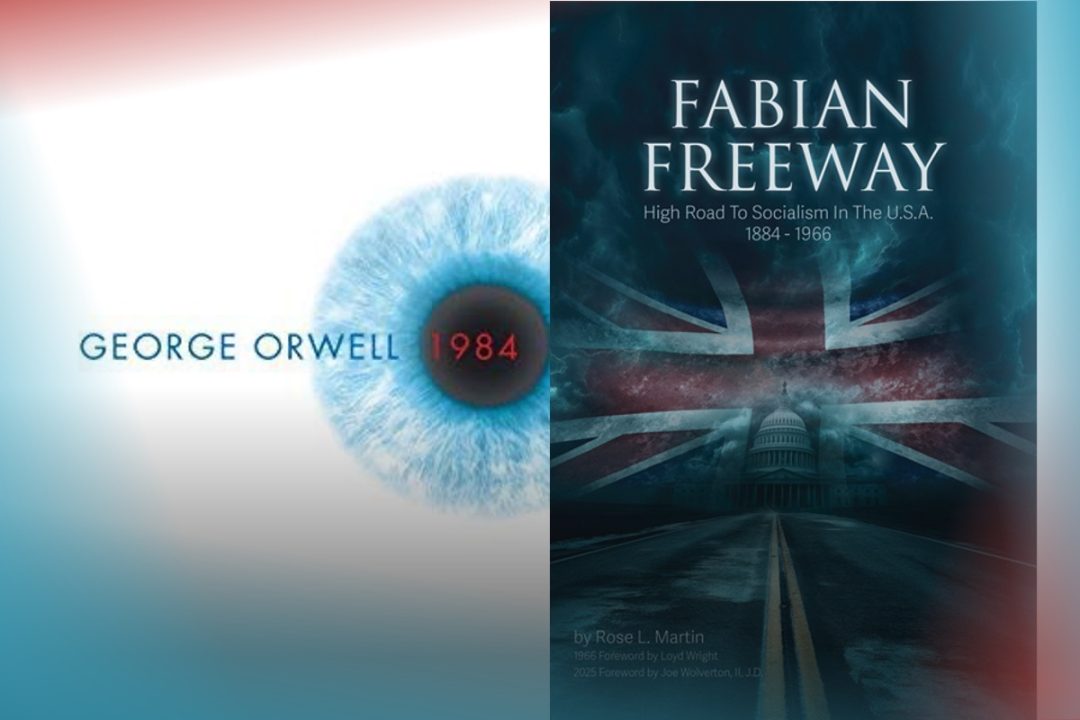
Following is a combined review of Fabian Freeway: High Road to Socialism in the U.S.A. 1884-1966 by Rose L. Martin and Nineteen Eighty-Four by George Orwell, both available from Western Islands Publishing.
If the United States is truly a free country as we like to boast, then why is our political landscape a better example of the 10 planks of the Communist Manifesto than the Bill of Rights of the U.S. Constitution?
Our income tax fulfills the second plank’s call for a “heavy progressive or graduated income tax.” The Federal Reserve embodies the fifth plank, which demands “centralization of credit in the hands of the state, by means of a national bank with state capital and an exclusive monopoly.” Plank 10, “free education for all children in public schools,” perfectly describes the modern system that daily indoctrinates our youth. Property taxes and bureaucratic strangleholds fulfill most of the other seven provisions that Karl Marx and Friedrich Engels proposed in order to transition nations from capitalism into communism.
Add today’s ubiquitous, propaganda-spewing screens that constantly monitor our habits, and our modern world bears a frightening resemblance to the nightmarish dystopia of George Orwell’s Nineteen Eighty-Four.
It is no coincidence that he had prophetic insights, for Orwell was a staunch leftist of whom Bernard Crick, his foremost biographer, wrote, “He made his name as a journalist by his skill in rubbing the fur of his own cat backwards.”
Orwell and the Fabians
What was his beef with those in his own camp? Orwell acknowledged that the Fabian vision could only result in tyranny, but he naively campaigned for an egalitarian world, illogically differentiating between collectivism and tyranny. “Every line of serious work that I have written since 1936 has been written, directly or indirectly, against totalitarianism and for democratic socialism, as I understand it,” he wrote in a 1946 essay, exposing his profound ignorance of the fact that socialism is the breeding ground of tyrants.
So he sought to expose those whom he identified as charlatans — power-hungry communists masquerading as bleeding-heart liberals — and whom he characterized in his 1937 non-fiction book The Road to Wigan Pier as “intellectual, tract-writing … fuzzy hair[ed] … mealy-mouthed … high-minded Socialist slum visitor[s].”
“The truth is that, to many people calling themselves Socialists, revolution does not mean a movement of the masses with which they hope to associate themselves,” he decried, “it means a set of reforms which ‘we’, the clever ones, are going to impose upon ‘them’, the Lower Orders.”
Such self-promoting, self-styled “intellectuals” had formed the Fabian Society in 1884, and more than a half-century later, their descendants were the primary targets of Orwell’s contempt. He was wise to dislike them, for by his day they had already embedded themselves strategically within the machinery of government, both in Britain and the United States. They took cues from Karl Marx, but worked to impose communism by nefarious subversion rather than overt revolution. Only their logo — a wolf in sheep’s clothing — revealed their purposeful stealth, by which no cancer ever grew so quickly.
Whether the title Nineteen Eighty-Four was a reversal of the year in which Orwell wrote the manuscript, 1948 (as his publisher stated), or a reference to the centenary of the Fabian Society’s founding (as some contend), the book amounts to his belief of where Fabian-styled influence was leading. Unfortunately, he did not live to see publication of the seminal work that would prove him correct.
Fabians Exposed
That work, written by American journalist Rose L. Martin, debuted in 1966 as Fabian Freeway: High Road to Socialism in the U.S.A., 1884-1966, a comprehensive, well-documented history of the society’s first six decades A few excerpts from each book will evince the parallels between Orwell’s 1948 fantasy, Martin’s 1966 reality, and the unfortunate Fabian fruition of our modern day.
“Fabians regarded themselves as an intellectual aristocracy destined to guide the masses toward a planned society, whether the masses desired it or not,” writes Martin, while Orwell’s Inner Party tyrant, O’Brien, tells the protagonist, Winston Smith: “The Party is not interested in the good of others; it is interested solely in power.” This is a remarkable description of our federal government today, though our Founding Fathers established a republic, intending to protect rights by rule of law.
“Fabians believed that society must be directed by a hierarchy of trained experts and administrators who alone possess the knowledge necessary for scientific social planning,” Martin states, whereas Orwell writes: “The Party consists of a hierarchy.… The new aristocracy was made up for the most part of bureaucrats, scientists, technicians, trade-union organizers, publicity experts, sociologists, teachers, journalists, and professional politicians.” The modern term for this is technocracy, and it’s been the playbook of our federal government for more than half a century.
“Fabian policy has always been to transfer ownership and control of the means of production from individuals to the State by a series of small, almost imperceptible steps,” Martin notes in a near verbatim repeat of Orwell’s statement: “All production is controlled by the State.… Private property in land has been abolished [and] theoretically there is no longer any private property at all.” Our own government is usurping rights and gobbling up private property through bureaucratic stranglehold and largely in the name of “sustainable development.”
“Fabians have shown an extraordinary talent for rewriting history to suit their current purposes … inconvenient facts are simply omitted or distorted,” says Martin, whereas Orwell’s protagonist has a job literally rewriting history at the “Ministry of Truth.” In fact, the Party’s slogan is: “Who controls the past controls the future; who controls the present controls the past.” Unfortunately, our own government has been rewriting history for decades, and indoctrinating our children for more than a century.
“Fabians early recognized the importance of capturing the educational system … to mold public opinion in the desired direction over a period of generations,” Martin reveals. Orwell describes this indoctrination with: “Don’t you see that the whole aim of Newspeak is to narrow the range of thought? In the end we shall make thoughtcrime literally impossible.” Watch out what you post on social media; arrests for thought crime are ubiquitous today.
Fabians in the United States
Naturally, Martin goes further than Orwell in weaving the Fabian tale of horror. Her painstaking research exposes how the Fabian hydra spawned heads in the United States such as the Intercollegiate Socialist Society, the League for Industrial Democracy, Americans for Democratic Action, and, most damaging of all, the American Civil Liberties Union. These groups quickly began to exercise powerful influence over national policy, while Fabian adherents captured key administrative positions within government and political parties. By the early 1960s, infiltration “was so widespread both in the White House and the [bureaucratic] Departments, that a few [personnel] changes really changed nothing at all.”
Fabian influence has grown since then by leaps and bounds. Today the group is best known in the United States as the Democratic Socialists of America, which pegs itself as the largest socialist organization in the country, “with over 80,000 members and chapters in all 50 states.” U.S. Senator Bernie Sanders (I-Vt.), U.S. Representative Alexandria Ocasio-Cortez (D-N.Y.), and New York City’s Democratic Mayor-elect Zohran Mamdani are some of its most well-known members. More than 250 members hold public office at local, state or national levels across the country.
Those who wish to learn the inner workings of the Fabian Society so we can stop its adherents in their tracks will find Martin’s exposé both illuminating and instructive. Fabian Freeway is one of a number of Americanist classics that The John Birch Society’s publishing arm, Western Islands, is bringing back to life. Be sure to add these to your 2026 reading list so you will be equipped in the fight to defend our nation against her enemies, especially those in our midst.