
UN’s Migration Queen Does Davos. Is U.S. Still Funding?
As we have reported, on January 7, President Trump issued an executive order terminating U.S. membership in and support of 66 international organizations and UN agencies. Hooray for that historic move! But, we have a question: Why wasn’t the UN’s International Organization for Migration (IOM) included on that list? The IOM is arguably one of the most destructive UN agencies. It is the engineer and paymaster for the horrendous migrant/refugee tsunami that is destabilizing and unraveling so many countries.
IOM Director General Amy Pope was living it up this week with the billionaires in Davos, Switzerland. She was networking with the globalist tech titans, banking barons, media moguls, and corporate captains who have been supporting and promoting the UN’s harmful migration policies that are ravaging countries worldwide but have been particularly targeted at the United States and Europe.
In an on-the-street video from Davos, an ebullient Amy Pope cheerfully reports that the global mass migrations her UN agency promotes and directs are a wonderful thing. “We’re unlocking new ways to mobilize support for people in crisis.” What about the “people in crisis” in the receiving countries who are experiencing devastating impacts on housing, welfare costs, welfare fraud, medical care, and crime caused by the migration waves? What about the millions of people who have been lured by IOM’s programs to migrate and have thus become genuine “people in crisis” as victims of scammers, traffickers, robbers, rapists, kidnappers, and drug cartels?
But Amy Pope (a CFR member and former Obama and Biden official) lives a privileged, pampered, protected life far from those concerns. Her fiefdom, the IOM, is headquartered in beautiful Geneva, virtually next door to the World Economic Forum’s global HQ. Her budget this year is $2.89 billion, but she’s begging for more — to help the “people in crisis,” of course.
As we reported in 2024 (Invasion USA — Globalist Summit Wants to Spur More Mass Migration), Pope called on international donors — meaning the United States and other “rich” (and hyper-indebted) countries to pony up $7.9 billion. Where does that money go? To pay for food, transportation, shelter, phones, legal assistance, cash debit cards, and cash payments to caravans of migrants. (See here, here, and here.) The colossal fraud that is coming to light among the Somali “refugee” population is but the tip of a very large iceberg that stretches across every state, affecting every community, not only those that have designated themselves “sanctuaries.” In the past, the United States has contributed as much as 40 percent of the IOM budget. The Trump administration reportedly has reduced funding to the IOM, but we have not been able to find out the current level of funding. Why not leave the IOM and cut all taxpayer funding of this monstrosity? —William F. Jasper

The Alien Disclosure Gambit: A Pretext for Global Economic Reset?
In a startling development that has sent ripples through financial circles, Helen McCaw, a former senior analyst in financial security at the Bank of England, has urged Governor Andrew Bailey to prepare for a potential market catastrophe triggered by nothing less than an official U.S. announcement confirming extraterrestrial life. McCaw’s letter warns of “total financial instability,” including bank runs, stock market plunges, and disruptions to global supply chains, should the White House validate the existence of aliens.
This comes amid whispers in Washington that President Donald Trump may be gearing up for a bombshell UFO disclosure speech on July 8, 2026 — the 79th anniversary of the infamous Roswell incident. The story broke into the public eye through social media, where conservative voices amplified the alarm. Retired U.S. Army Colonel Douglas Macgregor shared the news on X, highlighting McCaw’s credentials and the urgency of her plea.
“Breaking: Bank of England told to prepare for a market crash if the United States announces Alien Life,” wrote Macgregor. “Helen McCaw who served as a senior analyst in financial security at the UK’s central bank sounded the alarm. She has now written to Andrew Bailey, the Bank’s governor, urging him to organize contingencies for the possibility that the White House may confirm we are not alone in the universe.”

Similarly, Edward Dowd, a former BlackRock executive, pointed out that such a revelation could serve as a convenient scapegoat for an impending “demographic global debt collapse.” British filmmaker Mark Christopher Lee aired rumors that a Trump administration insider leaked details of the planned announcement on July 8, 2026, which would not only confirm Roswell as a real alien crash, but also verify ongoing extraterrestrial programs and even aliens living among us.
To understand the full implications, we must peel back the layers of government secrecy and globalist maneuvering. For decades, the U.S. government has drip-fed information on unidentified aerial phenomena (UAPs), from the Pentagon’s 2021 report admitting unexplained sightings, to whistleblower David Grusch’s 2023 congressional testimony alleging recovered non-human craft and biologics. Trump himself, during his first term, signed legislation mandating UFO disclosures within 180 days as part of a Covid-19 stimulus bill, though little materialized beyond vague acknowledgments.
Experts such as Nigel Watson, author of Portraits of Alien Encounters Revisited, predict 2026 could be the year of full disclosure, driven by mounting whistleblower activity. Documentary director Dan Farah, behind The Age of Disclosure, has gone further, suggesting Trump is “actively involved” and could release “bombshell non-blurry UFO photos” this year. Farah’s film posits that we’re entering an era where presidents might confirm non-human intelligence, with Trump potentially leading the charge.
Yet, skeptics abound. In Lee’s own video updates, the claims of the unnamed insider shifted from a September UN speech to the specific July date, raising questions about credibility and potential disinformation. From a constitutionalist perspective, this narrative reeks of an engineered crisis. Recall the warnings of Dr. Wernher von Braun, the German rocket scientist who helped build NASA’s Apollo program. In the 1970s, von Braun reportedly confided to his assistant Carol Rosin that the powers-that-be would stage a series of false threats to justify global control: first communism, then terrorism, asteroids, and finally, a fake alien invasion. “The last card is the alien card,” he allegedly said, “and all of it is a lie.”
This blueprint aligns eerily with today’s headlines, where economic turmoil, in the form of ballooning national debts, inflation, and demographic shifts, threatens the fiat currency system. As Dowd astutely notes, the real “crash” that concerns the elites is not a Roswell crash, but an economic crash rooted in policy failures such as endless wars, unchecked immigration, and central-bank manipulations that have eroded American sovereignty.
Consider the timing. Global debt exceeds $300 trillion, with the United States alone owing more than $35 trillion. Birth rates are plummeting in Western nations, straining social security systems, as an aging Baby Boom generation’s retirement engenders an economic domino effect across the economy.
In comments about the so-called GENIUS Act, President Trump coincidentally called for an overhaul of the U.S. economic system, saying, “Many Americans are unaware that behind the scenes, the technical backbone of the financial system is decades out of date … but payments and money transfers are costly and take days or even weeks to clear. Under this bill, the entire ancient system will be eligible for a 21st-century upgrade using the state-of-the-art crypto technology.”
So could an engineered crash set the stage for the pre-planned “upgrade”? Historical precedents abound. The 1938 War of the Worlds radio broadcast caused mass panic, illustrating how extraterrestrial narratives can manipulate public psychology. More recently, the 2020s saw governments use crises such as pandemics to expand control, from lockdowns to vaccine mandates. If aliens are “revealed,” expect similar tactics: fear-mongering media, suppressed dissent, and calls for “global cooperation” against a common threat.
True disclosure involves revealing the pattern of governmental manipulation and public-sector malfeasance. In the words of Founding Father John Adams, “Liberty cannot be preserved without a general knowledge among the people.” — Rebecca Terrell

Study: U.S. Experienced Negative Net Migration for First Time in More Than 50 Years
According to a new study, the United States experienced negative net migration for the first time in at least 50 years, reflecting the Trump administration’s efforts to restrict mass migration and increase deportations.
The report, authored by Wendy Edelberg, Stan Veuger, and Tara Watson of the Brookings Institution, examines the various forms of migration into (e.g., green cards, refugees, and illegal migration) and out of (e.g., deportations and self-deportations) the United States. Explaining their findings, they write:
Building on work released in late 2024 and mid-2025, we use available data combined with judgment to estimate a range of likely outcomes for net migration for the years 2025 and 2026. We conclude that net migration was likely close to zero or negative over calendar year 2025 for the first time in at least half a century. Specifically, we estimate that net migration was between -295,000 and -10,000 for the year. For 2026, we project net migration is likely to remain in negative territory.
Edelberg, Veuger, and Watson argue that because the One Big Beautiful Bill Act includes significant funding for immigration enforcement, the number of deportations and self-deportations will likely increase in 2026.
The authors also claim that “the slowdown [in migration] implies weaker employment, GDP, and consumer spending growth.” However, as The New American has previously noted, claims that mass migration is economically necessary are unfounded.
The Brookings Institution’s estimate of negative net migration may not be high enough. Last month, the Department of Homeland Security (DHS) issued a press release claiming that “more than 2.5 million illegal aliens” left the United States in 2025, including 605,000 deportations and 1.9 million self-deportations.
Commenting on the DHS’s numbers, Andrew R. Arthur of the Center for Immigration Studies writes:
Even with the sanctuary pushback and a largely hostile media nipping at its heels, DHS’s claim of 605,000-plus deportations since January 20 doesn’t sound that unlikely, particularly with the massive pool of unauthorized targets [Tom] Homan et al. have to choose from.
DHS also asserts in its press release that “1.9 million other illegal aliens have voluntarily self-deported since January 2025”.
The Center will soon release its latest figures on the recent drop in the unauthorized population, but a mid-November analysis by my colleague, Steve Camarota, estimated a decline in the foreign-born population (both legal and otherwise) of about 2.3 million between January and September, suggesting the 1.9 million self-deports by early December claimed by DHS is definitely in the ball park.
Regardless of the exact figures, it is clear the Trump administration’s deportation and enforcement efforts, deterrence of illegal migration, and restrictions on legal immigration, combined together, are significantly reducing migration levels to the United States.
Although Trump has limited mass migration, he is largely relying on laws that give the president much leeway in how to interpret and enforce them — either because the laws are vaguely written or they explicitly delegate congressional power to the president in violation of Article I, Section 1 of the U.S. Constitution. In order to ensure that Trump’s actions against mass migration remain permanent, Congress must enact stronger immigration laws that prevent individuals from single-handedly directing national policy. — Peter Rykowski

Trump Administration’s Bold Move: Defunding Sanctuary Cities to Restore Law and Order
In a decisive step toward prioritizing American sovereignty and public safety, President Donald Trump announced on January 13, 2026, that the federal government would withhold funding from so-called sanctuary cities and states starting February 1.
This policy revives efforts from his first term to crack down on jurisdictions that shield illegal immigrants from federal enforcement, citing threats to national security and local communities burdened by unchecked immigration.
The announcement, made during a speech at the Detroit Economic Club, underscores Trump’s commitment to enforcing immigration laws amid rising concerns over border security. “Effective February first, no more payments will be made by the federal government to states for their corrupt criminal protection centers,” Trump declared, accusing these areas of harboring criminals and undermining American workers. This move targets billions in federal grants, potentially affecting programs in housing, transportation, and law enforcement.
Sanctuary policies, adopted by various municipalities, limit cooperation with Immigration and Customs Enforcement (ICE) by refusing to honor detainers or share information on illegal aliens. Critics argue these policies create safe havens for criminal activity, draining taxpayer resources and endangering citizens. According to the Center for Immigration Studies, there are hundreds of such jurisdictions across the United States, including major cities such as Chicago, New York, and Los Angeles, as well as entire states such as California and Illinois. The Department of Justice’s updated list from August 2025 highlights places such as Albuquerque, New Mexico; Berkeley, California; and Boston, Massachusetts, as non-compliant.
Proponents of defunding point to real-world impacts. In Minnesota, for instance, investigations have exposed massive Social Security fraud linked to immigrant communities in sanctuary areas, costing taxpayers millions. There are obvious merits, therefore, in cleaning up this level of corruption.
On the negative side of the balance sheet, however, are constitutionalists who fear that (in a government that often stacks functions) an ulterior motive might be in play. That is to say, ICE has deployed advanced mobile surveillance technology to track and locate illegal immigrants, raising alarms about current activities being a mere beta-test for technologies that may be later used on American citizens. Known as Stingrays or IMSI-catchers (International Mobile Subscriber Identity), these devices are mounted in vans and mimic legitimate cell phone towers to intercept signals from nearby mobile phones. By tricking phones into connecting to the van’s signal instead of a real tower, authorities can pinpoint a target’s location, capture unique device identifiers, and even intercept communications data — all without traditional warrants in many cases.
This technology, originally developed for military and intelligence purposes, has become a tool in domestic immigration enforcement. In October 2025, reports revealed that ICE spent $825,000 on specialized vans equipped with cell-site simulators, enabling real-time tracking of suspects’ phones. These vans operate covertly, often in urban areas, where they broadcast a stronger signal to force phones to “lock on” to the fake tower. Once connected, the device collects IMSI numbers — unique codes tied to SIM cards — allowing agents to identify and locate individuals. This method has been used to facilitate deportations, with ICE confirming its deployment in operations targeting undocumented immigrants.
The process is insidious in its indiscriminateness. Unlike targeted wiretaps, Stingrays sweep up data from all phones within range, which can span several blocks or even kilometers depending on the device’s power and environment. In one documented instance, similar to reports of broad-area surveillance, devices have affected everyone in a vicinity equivalent to a 30-block radius in dense urban settings, switching their phones to the van’s signal and exposing innocent bystanders’ data. Critics highlight how these simulators vacuum up information from non-targets, including U.S. citizens, during ICE raids or stakeouts.
How that extraneous information is being used is anyone’s guess, especially given the fact that ICE has information exchanges with Israel (its agents are trained in part by the Israel Defense Forces). Legal battles loom, with suits already filed by the ACLU and others.
As February 1 approaches, the debate intensifies: Is this federal overreach or necessary defense of American interests? In the end, the president’s supporters hope that this action will reaffirm a core principle: Federal dollars should not subsidize lawlessness. But looming behind that hope is the specter of a concern, embodied by the Roman writer Juvenal, who said, “Quis custodiet ipsos custodes?” Translation: Who will watch the watchmen? — Rebecca Terrell

Australia’s Latest Firearms Ban and Free-speech Clampdown
Following the December 14, 2025, Islamic State-inspired terrorist attack at Bondi Beach that killed 15 people, Australia’s Parliament returned early from its recess for a special two-day session, passing two bills on January 20, 2026 that establish anti-hate-speech measures and expand firearm restrictions.
The firearms bill passed the House of Representatives by a 96-45 vote, and the Senate by a 38-26 vote. It establishes a massive national “buyback” scheme and imposes sweeping firearm restrictions, tougher background checks incorporating Australian Security Intelligence Organisation (ASIO) surveillance data, and stricter import controls.
The anti-hate-speech bill passed the House of Representatives by a 116-7 vote, and the Senate by a 38-22 vote. It expands “anti-hate speech” authority, imposing additional restrictions on speech, banning “hate groups,” adding harsher sentences for hate crimes, and enforcing visa cancellations for offenders.
Instead of focusing on radicalization and failed intelligence, Prime Minister Anthony Albanese’s government exploited the tragedy to rush through two oppressive bills, which enable the ASIO to decide who gets targeted, turning the intelligence agency into a government speech police.
Shadow Attorney-General Andrew Wallace, a member of the opposition Liberal National Party, said, “this bill reveals the contempt the government has for the million gun owners of Australia.”
Home Affairs Minister Tony Burke blamed legally owned firearms for the attack, stating that the two shooters, father and son, had “hate in their hearts and guns in their hands.” He failed to mention that the shooters were investigated by the ASIO in 2019 for ties to an Islamic State cell, but were incorrectly determined to be no threat.
These bills won’t stop terrorism. Instead, they are a thinly veiled, opportunistic power grab to disarm and silence law-abiding Australians. The Australian government has taken another shameful step toward completely disarming and silencing its own citizens. Sadly, Australia is only the latest country to weaponize crises to expand government control.
Importantly, this overreach erodes the God-given rights of free speech and to bear arms for self-defense. As the American Founding Fathers affirmed, rights come from God — they cannot be granted or taken away by governments — and governments have a duty to protect them.
True freedom comes from defending God-given rights, not from governments that restrict freedom following a tragedy. — D. Michael DeRidder

Will China’s Overproduction Lead to War?
China’s Belt and Road Initiative (BRI) is often dubbed “the modern Silk Road” because it weaves a network of infrastructure, trade, and investment across continents. Launched in 2013 by President Xi Jinping, the BRI aims to connect China with more than 150 countries through land and maritime corridors. Last year the initiative encompassed nearly 75 percent of the world’s population and more than half of global GDP, with cumulative investments surpassing $1.4 trillion. As we enter 2026, the BRI is expanding against a backdrop of mounting concerns over China’s domestic industrial overcapacity, which threatens to reshape international markets and spark trade frictions.
The past year marked a surge in BRI activity. According to the South China Morning Post, China signed a record $213.5 billion in new deals last year, a 75-percent increase from the previous year, encompassing construction contracts worth $128.4 billion and direct investments of $85.2 billion. This resurgence was driven by a focus on metals, mining, and energy sectors, particularly in Africa and Central Asia.
Eco-Business credits this aggressive expansion to China’s overcapacity challenges. Domestically, rapid industrialization has led to excess production in key sectors, including steel, solar panels, wind turbines, electric vehicles (EVs), and batteries. In green industries alone, factories churn out more than the home market can absorb, fueling cutthroat price wars and below-cost sales that erode profits. Official estimates suggest that in 2024, these sectors contributed 10 percent to China’s GDP and created 7.4 million jobs, making curtailment politically sensitive for local governments reliant on them for revenue and employment.
The BRI serves as a vital outlet. According to a report from Caixa Bank Research, “The BRI has become a key element for China’s global positioning. Faced with weakened domestic demand and chronic overcapacity, the initiative has facilitated the opening up of new markets, the diversification of export destinations, the
dominance of value chains for critical commodities that are essential for its industrial development, and the reduction of dependence on geo-economic rivals, a factor that has gained particular importance in recent years.”
The operative phrase is “chronic overcapacity.” One of the blessings of the Industrial Revolution is factory production and its ability to lower prices for consumers. One of the curses is overproduction. If a factory makes too many shoes, for example, that surplus has to be warehoused, which can be costly.
A hundred years ago, the founder of the field of public relations, Edward Bernays, weighed in on the challenges of overproduction. The way the West dealt with it was to encourage overconsumption in the public. One of the drivers of this, according to Bernays, was fashion. By this method, one could induce a consumer to buy four new pairs of shoes when he only needed one, and to throw away perfectly good items by convincing him that they were “out of fashion.” Gluttony, in other words, became part of a larger business model.
In his 1928 book Propaganda, Bernays wrote, “Mass production is only profitable if its rhythm can be maintained — that is, if it can continue to sell its product in steady or increasing quantity. The result is that while, under the handicraft or small-unit system of production that was typical a century ago, demand created the supply, today supply must actively seek to create its corresponding demand. A single factory, potentially capable of supplying a whole continent with its particular product, cannot afford to wait until the public asks for its product; it must maintain constant touch, through advertising and propaganda, with the vast public to assure itself the continuous demand which alone will make its costly plant profitable.”
China, with its shrinking population, cannot domestically consume the vast array of products it creates, which engenders the natural pressure to offload its surpluses internationally — hence its need for the Belt and Road Initiative. This brings it into conflict with competing empires, which do not want their trade routes bypassed by the Belt and Road Initiative (and the consequent loss of tariff revenues that this would constitute for them). Just as President Trump is vaunting the wealth that can be generated by tariffs for America, China’s assertion of a land-based trade route is perceived as a threat and will foreseeably ramp up tensions between East and West.
This is a logical consequence of industrialization. Adam Smith in The Wealth of Nations discusses how, when a new nation goes through the industrial revolution, this adds yet another player to the geopolitical chess board, as players vie for the raw materials to make products, which leads them into direct competition for colonies and trade routes. Historically, this has caused international tensions and, at the extreme end, war.
In his book Destined for War, Harvard’s resident China scholar Graham Allison refers to the dangerous structural tension that arises when a rapidly rising power threatens to displace an established ruling power, often leading to war due to fear, mistrust, and miscalculation. He calls it Thucydides’ Trap — coined from the ancient Greek historian Thucydides’ observation about the Peloponnesian War: “It was the rise of Athens, and the fear that this instilled in Sparta, that made war inevitable.”
The idea has been applied directly to contemporary U.S.-China relations. China, with its explosive economic growth, military modernization, and expanding global influence through initiatives such as the Belt and Road Initiative, is seen as the rising power challenging America’s long-standing supremacy as the post-World War II dominant force. Allison’s analysis of historical cases shows that in 12 out of 16 similar rivalries over the past 500 years, conflict erupted, making war between the U.S. and China a plausible — though not inevitable — outcome if leaders fail to manage the resulting conflict of interests between the powers. — Rebecca Terrell

Chinese Births Fall to Lowest Level Since 1949
Births in China have fallen to the lowest level since 1949, the year communists took over the country.
The Associated Press reports:
A decade after ending China’s longtime one-child policy, the country’s authorities are pushing a range of ideas and policies to try to encourage more births — tactics that range from cash subsidies to taxing condoms to eliminating a tax on matchmakers and day care centers.
The efforts haven’t paid off yet. At least, that’s what population figures released Monday [January 19] show for what is now the world’s second-most populous nation. China’s population of 1.4 billion continued to shrink, marking the fourth straight year of decrease, new government statistics show. The total population in 2025 stood at 1.404 billion, which was 3 million less than the previous year.
Measured another way, the birth rate in 2025 — 5.63 per 1,000 people — is the lowest on record since 1949, the year that Mao Zedong’s Communists overthrew the Nationalists and began running China. Figures before that, under the previous Nationalist government, were not available.
China was long the world’s most populous nation until 2023, when it was surpassed by regional neighbor and sometime rival India. Monday’s statistics illustrate the stark demographic pressures faced by the country as it tries to pivot from a problem it is working hard to overcome: status as a nation with a growing but transitional economy that, as is often said, is “getting old before it gets rich.”
These statistics show the failures — and dangers — of government-imposed population planning. They also cast doubt on China’s ability to sustain its economy and geopolitical position in coming decades. — Peter Rykowski

The Copper Imperative: A Blueprint for Resource Wars in the Technocratic Era
In an era of accelerating technological advancement, the world’s insatiable hunger for critical minerals such as copper is poised to reshape geopolitics, economies, and potentially ignite global conflicts. Mining magnate Robert Friedland, speaking at the 2025 Energy Business Summit at USC, delivered a stark warning: “To maintain global 3 percent GDP growth, we have to mine the same amount of copper in the next 18 years as we mined in the last 10,000 years (combined) … without electrification, without data centers, without solar and wind and the greening of the world economy. You people have no idea whatsoever what we’re facing. You’re dreaming.” This projection underscores a baseline demand driven by traditional growth, but Friedland emphasizes that emerging technologies will exacerbate the shortfall, demanding unprecedented extraction efforts.
Echoing this urgency, journalist Ed Conway quantifies the scale in his book Material World: “On the basis of one calculation, we will need to mine more copper in the next 22 years than we have in the entirety of the past 5,000 years of human history.” Conway’s analysis highlights how modern civilization’s reliance on materials has already surpassed historical totals. In 2019 alone, humanity extracted more resources than in all of history up to 1950. Yet, the push toward net-zero emissions and digital infrastructure will intensify this, as copper forms the backbone of electrical grids, renewable energy systems, and data networks.
These statements reveal a deeper narrative: The resources fueling this boom are essential for constructing what critics describe as the “surveillance capitalism” that underlies the technocratic model that the global elite wishes to install. These power players, through global initiatives, are building an interconnected web of AI-driven data centers, smart cities, and electrified transport — all reliant on copper for conductivity and efficiency. Data centers alone, powering AI surveillance and predictive algorithms, could consume vast quantities of this metal. Electric vehicles and renewable grids enable centralized control over mobility and energy, embedding tracking mechanisms into daily life. Without massive mining escalations, this vision falters, but the pursuit risks environmental devastation and social upheaval.
Enter Ricardo Hausmann’s “Atlas of Economic Complexity,” a visionary tool mapping countries’ productive knowledge and export structures. Developed at Harvard’s Growth Lab, the Atlas visualizes economic drivers, including natural resources such as copper, revealing concentrations in nations such as Chile, Peru, and the Democratic Republic of the Congo. By quantifying “product space” — the web of related goods a country can produce — it predicts growth paths but also exposes vulnerabilities. Resource-dependent economies, such as those in mineral-rich regions, occupy sparse areas of this space, limiting diversification and heightening geopolitical tensions.
As demand surges, the Atlas serves as an inadvertent blueprint for future wars: Superpowers may vie for control over these hotspots, mimicking historical scrambles for oil or rare earths. Conflicts could erupt in South America or Africa, where copper mines become strategic assets in the technocratic arms race.
Ultimately, Friedland and Conway’s prognostications, illuminated by Hausmann’s insights, warn of a precarious future. The stated need for rare earth elements
and natural resources (such as copper or silver) grants us an insight into current U.S. military actions in Venezuela or the president’s open desire to acquire Greenland. The next era’s battles may not be over ideology, but over the very elements enabling elite dominance. — Rebecca Terrell
Jeffrey Epstein Lives On at Davos
As the jet-setters arrive at Davos, so do the “sex workers.” That’s the preferred euphemism for prostitutes these days. Or, better yet, “escorts.” “Prostitute” has that nasty old Biblical, judgmental ring to it. The major corporate media don’t report it, of course, because, well, they might lose their privileged entre to the annual event. Then too, some of them may be participants in the WEF sexcapades themselves.
However, over the past several years, some of the European press have dared to report on the less-than-pristine behavior of “the great and the good” at these soirees that are billed as gatherings to “build a better world.” The German Bild, the largest circulation daily newspaper in Europe, and the British Daily Mail have published stories reporting on the “escort services,” i.e., pimps, that provide hundreds of young ladies for “dates” and sex orgies for the World Economic Forum attendees. WEF “clients” reportedly pay thousands of dollars per night for the ladies’ services. Saving the world is such a tough business! — William F. Jasper
Great American Heist: Elites’ $50 Trillion Transfer From American Workers to Global Empires
In an interview on The Shannon Joy Show, financial whistleblower Catherine Austin Fitts laid bare what she calls a monumental “bank robbery” orchestrated by Washington’s uniparty elite. Drawing on decades of experience as a former Assistant Secretary of Housing and Urban Development, Fitts detailed how $55 trillion has vanished from the U.S. economy since 1998. She breaks it down: $21 trillion in “undocumentable adjustments” at the Department of Defense (DOD) and HUD from 1998 to 2015, $29 trillion in bailouts during the 2008-2012 financial crisis, and another $5 trillion injected via the Federal Reserve’s “Going Direct” reset amid the 2019 pandemic.
“We don’t have a financial problem,” Fitts asserted. “We’ve got bank robbery.” This staggering sum, she argues, wasn’t lost to incompetence but deliberately siphoned by insiders to fund shadowy agendas, leaving everyday Americans footing the bill through inflation, debt, and eroded savings.
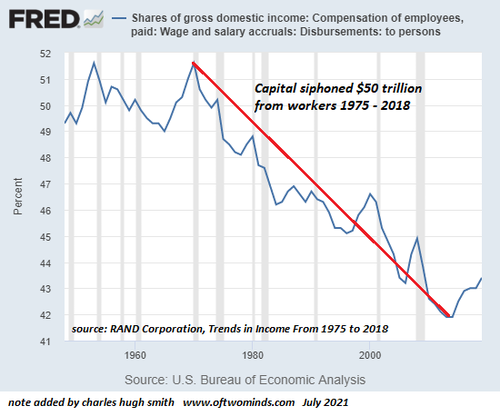
Echoing Fitts’ revelations, economic analyst Charles Hugh Smith has documented a parallel plunder in his blog Of Two Minds. Referencing a 2020 RAND Corporation study on income trends from 1975 to 2018, Smith highlights how $50 trillion was effectively transferred from American workers to the top one percent. The study contrasts post-World War II equitable growth, when incomes rose across all classes, with the post-1975 era of skyrocketing inequality. If growth had stayed balanced, incomes for the bottom 90 percent would have been $2.5 trillion higher in 2018 alone, culminating in a $47 trillion shortfall over four decades. Smith’s annotated graph from the U.S. Bureau of Economic Analysis illustrates this starkly: Labor’s share of gross domestic income plummeted from 51 percent in 1975 to 42 percent by 2018, with capital claiming the difference. He labels it thus: “Capital siphoned $50 trillion from workers,” attributing the shift to financialization, where Wall Street prioritizes stock buybacks, executive bonuses, and asset bubbles over wage growth.
The convergence of Fitts’ and Smith’s claims paints a damning picture. This embezzlement wasn’t random, but a strategic wealth transfer from the American working class to empower global elites. Fitts connects the dots to globalization’s acceleration after the 1995 Uruguay Round and World Trade Organization’s creation, which fluidized capital flows and equalized labor costs worldwide. Trillions in “missing” funds, she suggests, were redirected to build parallel systems, including massive investments in East Asia’s manufacturing hubs. Policies such as offshoring jobs to China and other low-wage nations — enabled by trade deals such as NAFTA and China’s WTO entry — hollowed out U.S. industries while building out East Asia as the world’s manufacturing hub.
Smith concurs, arguing that globalization’s “wage arbitrage” shifted high-paying manufacturing overseas, benefiting capital at labor’s expense. U.S. elites funneled siphoned wealth into Asian factories, supply chains, and infrastructure, transforming China into the world’s workshop. This created trillion-dollar trade deficits, funded by American debt, while workers faced stagnant wages, deindustrialization, and community decay. The result? A bifurcated global economy where East Asia booms on pilfered U.S. capital, and American middle-class dreams evaporate.
This heist has profound implications. As Fitts warns, it’s funding a “leveraged buyout of the world,” eroding democracy and sovereignty. Smith predicts social unrest from unchecked inequality. With national debt soaring and trust in institutions crumbling, reclaiming this wealth demands transparency, audits, and policies prioritizing domestic strength over globalist agendas. Until then, the American dream remains collateral in the World Economic Forum’s larger global scheme. — Rebecca Terrell
NYMHM: News You May Have Missed
Will the Globalist Order Survive Trump?
Larry Fink: Making People “Care” About the WEF Agenda
Black Researcher: MLK, Jr. Was a Marxist Who Rejected Christ; “Pastor” Title a Ruse
Carney Doubles Down on Incremental New World Order Push at WEF
Enemy Powers Using Immigration as a Weapon to Destroy U.S., Author Warns
Thomas Massie on Reelection and Why the Establishment Wants Him Gone
Hidden Agenda: This is the REAL Reason the Dems and Media Hate ICE
Senator Mark Lapka’s Bold Plan to Protect Rural Landowners from Eminent Domain
War on Sheriffs: Deep State Dems Attack
Why Trump’s Push for U.S. Control Over Greenland Is Anything but Crazy
[END]