Condition 1984: Flock AI Cameras Surveilling U.S.
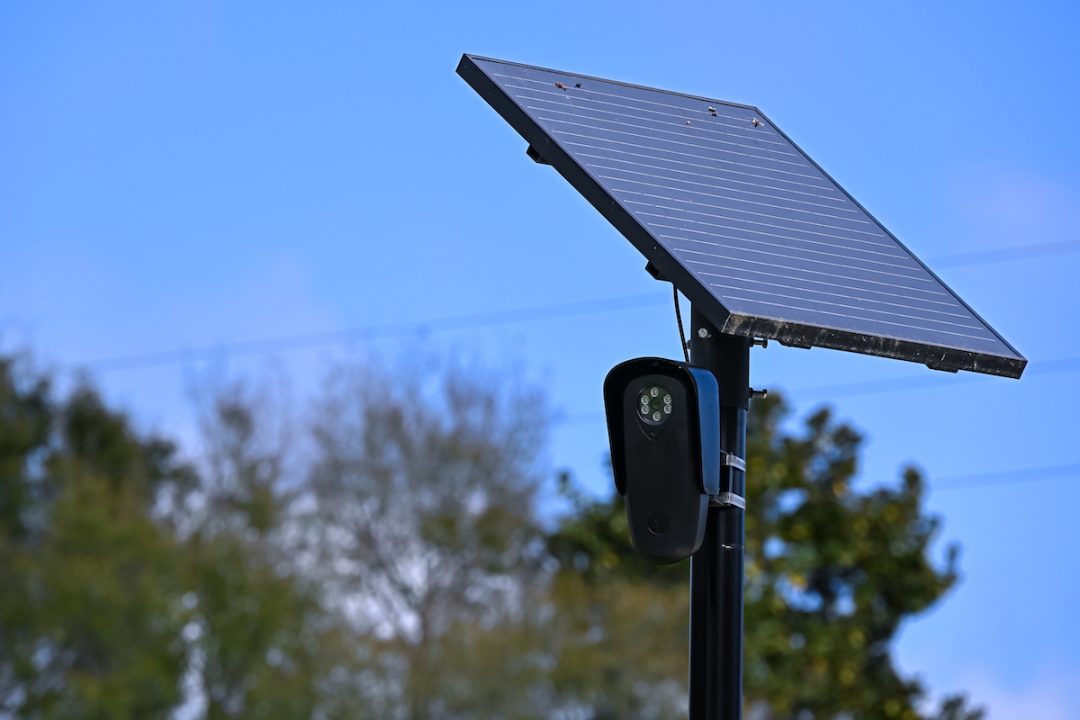
From Los Angeles to New York, from the deep South to Midwest suburbs, more than 80,000 AI-powered cameras are actively surveilling nearly every American as they commute to work, walk their dogs, and drive to church. The company behind it, Flock Safety, is claiming to fight — and even prevent — crime, but the reality is more sinister.
Flock and companies like it are building the foundation for a surveillance state that would make George Orwell blush. They are accomplishing this by installing high-tech AI cameras on every street corner, positioning them in every neighborhood, and even launching AI eyes in the sky through a drone network.
The Goal: No Crime
The company, founded in 2017 with an evaluated value of $7.5 billion, exists to aid law enforcement and “stay ahead” of any threat “big or small.” More than 5,000 law-enforcement agencies use the tech in 49 states (Alaska being the outlier), according to Flock’s website, which it boasts represents the “largest public-private” surveillance network.
Garret Langley, Flock CEO and co-founder, says the company’s objective is to eliminate crime — all crime. In an interview with Forbes, Langley explained that Flock’s “full mission is that we genuinely don’t think that crime should exist…. We think that with technology, with people, with policy, crime can be a thing of the past.” In other words, with enough spyware and surveillance, every movement can be monitored.
Flock’s objective frighteningly resembles the plot of the 2002 dystopian film Minority Report starring Tom Cruise, in which the fictitious “PreCrime” division of the police department predicts and stops crime before it ever takes place.
Flock AI cameras are not simply license plate readers. Units run 24/7 and detect the “fingerprint” of a vehicle, such as the make and model as well as characteristics such as color, dents, scrapes, broken windows, and even bumper stickers. All this information is then stored in Flock’s AI brain.
With Flock cameras, data can be collected by private individuals and companies; law enforcement and corporations can receive alerts from the cameras in real time; data is stored in an AI cloud accessible nationwide rather than on a native drive managed by local law enforcement; and, perhaps most significantly, Flock cameras gather personal vehicle characteristics rather than simply the license plate number. Plus, many cameras are equipped with gunshot detection technology to geolocate individuals operating firearms.
Langley explained that the system is so precise that you can ask Flock’s AI brain, Freeform, to find a Ford F150 from the 1990s with a racing stripe and rust on the hood, and it will find the vehicle immediately.
Taking It to the Skies
Flock Safety is not limiting its surveillance grid to merely roadside cameras. In fact, it is launching drones that can track down offenders that the cameras locate.
The company’s high-tech Flock Alpha drone can travel up to 60 miles per hour, cover 50 square miles of territory, and is even equipped with thermal night vision. Simply put, it can see and access everything and everyone.
Flock advertises on its website that its drones will be used to respond to the sounds of gunshots, track down vehicles identified by its legion of street cameras, and contribute to the crusade to eradicate all crime.
In another Forbes interview with Langley, the publication gives an eerie account of a Flock drone demonstration:
In a test drive, a drone in Riverside County, California, rises from the roof of a Flock facility on the outskirts of town. Controlled via browser, with just a keyboard and mouse, it’s like playing a video game — no surprise given that Flock employed developers from the Overwatch first-person shooter game series to build it. Text pops up to explain what’s on the screen: a mental health care center, a McDonald’s. Then, with a simple scroll of the mouse, the camera zooms in on two men playing softball on a field hundreds of yards in the distance. The batter misses one, then hits a doozy. He has no idea he’s being watched from a surveillance company’s factory 2,000 miles away.
Behind Flock: Silicon Valley Funding
Of course, Flock Safety could not become the $7.5 billion empire it is today without help. Two significant funders behind Flock are Palantir CEO Peter Thiel’s Founders Fund, a $17 billion venture capital outfit, and Andreessen Horowitz (often referred to as a16z). Both funders are at the tip of the spear in AI-powered intelligence, Big Tech, and defense weaponry.
These connections are concerning, especially considering that Thiel’s Palantir, a company that exists to collect data on Americans, received seed money from the CIA and has active contracts with the Department of Defense, Homeland Security, the National Security Agency, and the FBI to collect and analyze data on civilians to build a predictive policing state.
The other major funding outfit, Andreessen Horowitz — founded by Marc Andreessen and Ben Horowitz — is considered the premier Silicon Valley venture-capital firm. In 2012, Business Insider wrote that the firm is so mighty that “if they want in on a deal, they get in on a deal.”
It’s hard to find a tech company that Andreessen Horowitz does not have ties with. The firm has massively invested in X (formerly Twitter), Elon Musk’s xAI, Skype, Substack, Facebook, and even the video game Roblox, which has been exposed to be a premier grooming site for online sex traffickers.
In an announcement last year, Flock shared that they received over a quarter of a billion dollars in funding from the groups, which would help them build “investigative intelligence” and more drones.
Clearly Flock Safety’s formula to spy on Americans holds massive value with the biggest players in AI, surveillance, and defense technologies.
Connecting With Ring Doorbells and Amazon
Earlier this year, Flock made national news when Amazon founder Jeff Bezos’s Ring doorbell company partnered with Flock to launch a campaign called “Search Party” to help find lost dogs. The idea was to use all the Ring video doorbell cameras to search for missing pets and integrate Flock’s AI-powered street cameras in the effort.
The campaign received public backlash when Ring aired a commercial during the Super Bowl illustrating how Ring’s new AI could find the rogue pets by tapping into everyone’s doorbell cameras through Big Brother-style surveillance.
“I don’t think there is a better possible ad to get rid of your Ring camera,” one commenter said in reaction to the ad. “I like how they used pets to try and lowball 24/7 AI tracking to us,” another noted.
After the backlash became viral, Ring announced that the Flock partnership was dead in the water. “We determined the planned Flock Safety integration would require significantly more time and resources than anticipated,” Ring said in a statement. “As a result, we have made the joint decision to cancel the planned integration.”
Even Democratic Senator Ed Markey (D-Mass.) hopped on the critic’s bandwagon, posting on X, “Ring’s Super Bowl ad exposed a scary truth: the technology in its doorbell cameras could be used to hunt down a lost pet … or a person. Americans oppose this creepy surveillance state. Amazon must discontinue its dystopian monitoring features.”
DeFlock: “Terrorist” Resistance
Resistance to Flock’s ever-growing swarm of spy cameras is growing. Perhaps the largest organized group exposing the push is DeFlock, a website and community that reports and maps out the locations of the cameras across the nation.
“Our mission is simple: to shine a light on the widespread use of ALPR [automatic license plate reader] technology, raise awareness about the threats it poses to personal privacy and civil liberties, and empower the public to take action,” DeFlock states on its website.
Public consent and education are crucial, DeFlock argues, highlighting that a private company constantly spying on Americans without a warrant or consent is unlawful and dangerous. You can view DeFlock’s map of more than 80,000 registered Flock cameras here.
Flock CEO Langley was asked by Forbes about resistance to the AI surveillance state and rising privacy concerns. “Unfortunately, there are terrorist organizations like DeFlock,” Langley said. “They are closer to Antifa than they are to anything else.”
Langley also created a false dichotomy that beggars belief: “I think we can have a crime-free city and civil liberties…. We can have it all.” U.S. Founding Father Benjamin Franklin shared the opposite sentiment when he noted that “Those who would give up essential Liberty, to purchase a little temporary Safety, deserve neither Liberty nor Safety.”
Fourth Amendment Issue
Many citizens are growing concerned about how Flock might infringe on their Fourth Amendment-protected right to be secure in their “persons, houses, papers, and effects, against unreasonable searches and seizures” without a warrant.
Nathan DiPietro, a Florida-based researcher and citizen journalist who has been investigating and speaking to groups about the Flock scheme, told The New American that “new technology has a way of challenging our understanding of the balance between privacy and enforcing the law.” But DiPietro advises enhanced caution. “As those who believe in the rule of law, it can be easy at first glance to think Flock’s technology is in line with that ideal. But the more you dig deeper, the more you discover that the alleged safeguards in place are far less than adequate.”
“It’s likely that in the next 5-10 years the Supreme Court will have the opportunity to rule on the Fourth Amendment questions at play with these technologies,” he continued. “But until then, we must use the legislative process to ensure that our government has specific safeguards in place to ensure the privacy of American citizens is protected.”
Flock for Stalk: Misuses
Flock has received sizable pushback for operating under bad licenses, misreading plates, and getting vehicle “fingerprints” wrong, leading to innocent citizens being stopped and harassed. The tech is even being weaponized by law enforcement to stalk people.
One such instance was in Echols County, Georgia, where Anna Altobello, an employee of the sheriff’s office, used Flock data for personal inquiries on individuals. In Sedgwick, Kansas, local police chief Lee Nygaard used Flock cameras to run his ex-girlfriend’s tags a whopping 164 times. He even ran the tags on her boyfriend 64 times. These two examples are just the tip of the iceberg of scandals involving the technology.
Privacy is an essential pillar of liberty, and Americans should be wary of any outfit — public, private, or both — that seeks to cover cities, towns, and neighborhoods in a flurry of AI-powered cameras with drone backups in the sky.
The answer to 1984 has always been — and always will be — the spirit of 1776, which tolerates no infringement of liberty.