

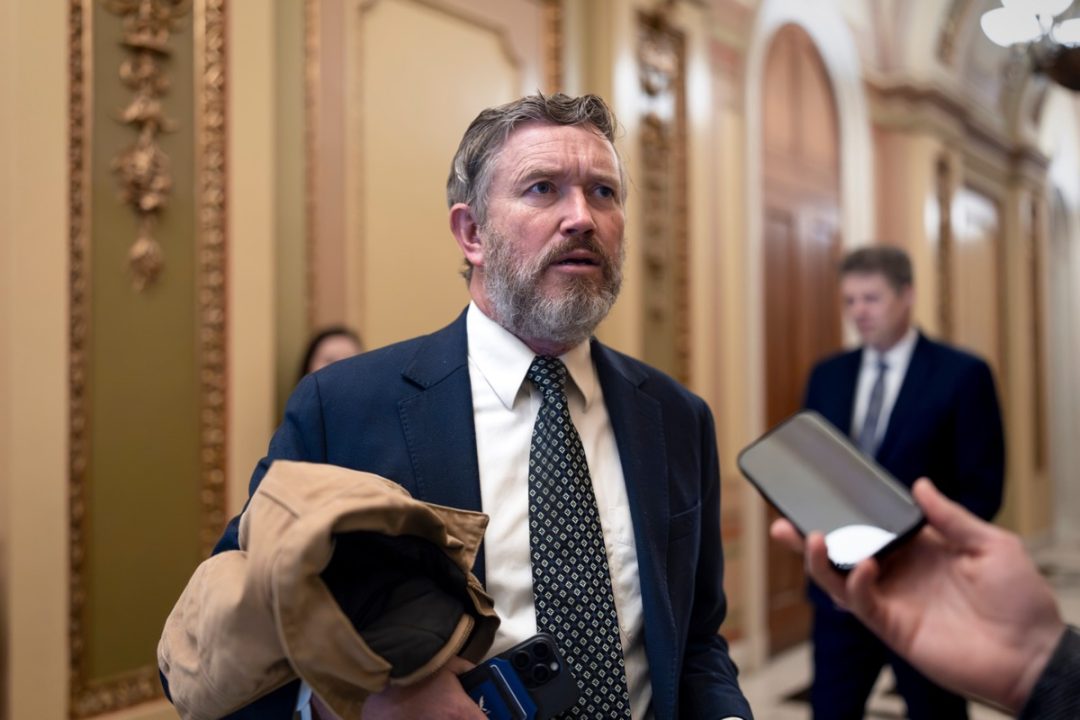
Trumpism vs. Americanism: Will Massie Prevail in 2026?
On May 19, the voters of northern Kentucky will decide what type of Republican they’ll elect to the House of Representatives: a party loyalist or a constitutionalist.
Since 2012, the people within Kentucky’s 4th Congressional District have chosen a rare breed of politician — a principled one. Thomas Massie is one of a handful of House members who take the U.S. Constitution seriously — so seriously that he’s been willing to serve as President Donald Trump’s punching bag over it. The other major choice these Kentuckians will consider is former Navy Seal-turned-farmer named Ed Gallrein, who is backed by Trump.
This GOP primary race might just be the most important contest of 2026. It carries implications that stretch beyond the district’s boundaries, and even beyond those of the Bluegrass State. Globalist-oriented billionaires with no connection to Kentucky whatsoever are spending millions to oust Massie. On the other side, more than 15,000 Americans have donated to Massie’s campaign. The race will reveal whether Americanist principles can survive, even thrive, in the political capital of the world. Moreover, this race will reveal if decent people who refuse to stay within the ideological bounds of the Uniparty can survive in American politics. Yes, there are other Republicans who, like Massie, hold libertarian, paleoconservative-type positions. But none of them has agitated the president so much in so little time.
The Epstein Files Release
As this writer was wrapping up this article, Massie was taking a victory lap. On January 30, the Justice Department released a trove of new documents related to suspected international sex trafficker and probable intelligence asset Jeffrey Epstein. The file dump totaled more than three million documents. They weren’t all new items, but there was a lot of fresh material, enough to trigger a torrent of renewed outrage, speculation, outright shock, and elite fallout.
Massie was one of two House members who co-sponsored the legislation that led to the release of the Epstein files, the other being Ro Khanna (D-Calif.). The two are continuing to fight because. Despite the voluminous nature of the initial release, it only included half of the documents the law required the DOJ to make public. Moreover, at least 70 percent of them were released with illegal redactions, the lawmakers pointed out. Worse yet, the government illegally withheld critical items. There was nothing in the new tranche identifying other men to whom Epstein trafficked minors. Also missing were the forms summarizing victim and witness statements that FBI agents normally fill out, known as FD-302 forms.
After the release, Massie and Khanna stayed on the DOJ like a dog on a bone, hounding the agency to reveal more as the law requires, which it did. The files corroborated suspicions that Epstein was heavily tied to intelligence, including Israel’s Mossad. They also suggested, based on Epstein’s own words, that he worked for the nefarious Rothschild globalist banking dynasty.
Insiders Implicated
The contents of the files toppled a number of European officials, including Britain’s Peter Mandelson, Sweden’s Joanna Rubinstein, Slovakia’s Miroslav Lajčák, and Norway’s Thorbjørn Jagland, who’s been charged with corruption. As for American power players, the files revealed that tech tycoon Elon Musk wanted to “party” at Epstein’s island. They prompted calls for Trump’s commerce secretary, Howard Lutnick, to resign because he lied about cutting ties with Epstein before his 2008 conviction. It turned out he kept in touch long afterward. They also reinforced long-held suspicions that Epstein’s early benefactor, billionaire Leslie Wexner, was a co-conspirator. And the files forced Obama Cabinet member Kathryn Ruemmler to resign as Goldman Sachs’ top lawyer.
For many months before he signed the Epstein Files Transparency Act into law, Trump used his force-of-nature personality to try and make the issue go away. Despite his campaign promises to the contrary, it became obvious the president had no intention of using his power to get the Epstein files released. He lashed out over public pressure for transparency numerous times, calling the Epstein saga a “Democrat hoax” and viciously scolding reporters when they brought up the subject. At one point, he even called his own supporters “stupid people” for demanding transparency. But thanks to Massie, Khanna, House Democrats, and the three House Republicans whose early efforts created the momentum that led to transparency, the president was eventually pressured into signing the legislation.
Trump vs. Massie
A few days after the January 30 release, Trump called Massie a “moron” while speaking at the 74th National Prayer Breakfast. The insult was part of a diatribe during which the president complained that Massie “never” voted with Republicans. The claim, while false, was rooted in a few kernels of truth. As Massie has repeatedly said, “I vote with Republican leadership 91 percent of the time. Nine percent of the time they’re protecting pedophiles, prioritizing corporations over farmers, spending us into oblivion, or starting another war.” On the other hand, Massie consistently votes in accordance with the Constitution. His lifetime score on this magazine’s Freedom Index is an impressive 99 percent.
Massie began bucking party consensus before Trump even took office in January. Just days into 2025, he cast the sole Republican vote against Representative Mike Johnson (R-La.) for speaker of the House, against Trump’s wishes. A couple of months later, in March, Massie was the only Republican who voted against the House Continuing Resolution budget measure on the grounds that it perpetuated wasteful spending, a point he makes often. And then a couple of months after that, he voted against Trump’s signature legislation, the One Big Beautiful Bill Act (OBBBA) — twice — on the basis that it was too big. Of course, Democrats voted against it because they considered it too small.
Unconstitutional Military Action
While the OBBBA was grinding its way through the chambers of Congress, Trump ordered a military strike on three Iranian nuclear enrichment sites. Massie disapproved, pointing out on social media that the strikes were unconstitutional, since there was no declaration of war. He then went on CBS’s Face the Nation and said it was “a good week for the neocons and the military-industrial complex, who want war all the time.” He also pointed out that Iran posed no imminent threat to Americans and that attacking it was contrary to Trump’s anti-war campaign promises:
We are tired from all of these wars, and we’re non-interventionists. I mean, this was one of the promises. … Are you going to call President Trump’s campaign an isolationist campaign? What he promised us was we would put America first.
Trump shot back with a long Truth Social rant filled with insults. He called Massie a “negative force,” a “simple minded grandstander,” a “lightweight Congressman,” “weak,” “ineffective,” and a “pathetic LOSER.” In that same message, the president announced his intention to push the congressman out. Not long afterward, news broke that people who work for the president had launched a PAC named MAGA KY. In late June, the PAC released a brutal and disingenuous ad that claimed Massie opposed banning sex-change operations on minors, cutting taxes, and securing the border.
Billionaires Backing Gallrein
According to the Federal Election Commission (FEC), major MAGA KY backers include neocon billionaires John Paulson, Paul Singer, and the Preserve America PAC, whose primary financier is Miriam Adelson. Some of these people have also contributed to Democrats or pro-LGBTQ causes. And all three are big supporters of continued U.S. foreign aid to Israel. Massie believes the Israel issue is the main reason they want him out of Congress. For the record, he doesn’t support foreign aid to any country, which is a wholly constitutional position.
Another interesting tidbit is that a month before Trump’s Venezuela operation on January 3, Singer acquired, through his hedge fund, Citgo Petroleum. Citgo, it just so happens, has a major presence in Venezuela. And now that the United States will essentially control Venezuela’s oil industry, Singer “is one of the big winners,” as Fortune noted.
Ed Gallrein
Massie’s main opponent in May’s primary, Gallrein, is a dairy farmer who ran for Kentucky’s Senate in 2024 and lost in the GOP primary to another former Navy SEAL. Gallrein has an extensive military background. In addition to being a former SEAL, he also was an Army Ranger. Judging by his rhetoric when he ran for state office, Gallrein subscribes to the neocon foreign policy that Trump is largely implementing. In a conversation with local radio broadcaster WHAS, he indicated that he supported intervention in Iran and Ukraine. It’s telling that Gallrein donated to one of the most notorious warmongers in Congress, Senator Lindsey Graham (R-S.C.). The winner of May’s primary is expected to hold the House seat, since a Democrat hasn’t won that district since 2000.
Massie believes Gallrein is Trump’s attempt to “keep all the horses from getting out of the barn” — i.e., to make sure no other Republicans get any crazy ideas about bucking the president’s wishes and policies. This contest will reveal if voters permit intra-party dissent, particularly dissent on constitutional grounds. At its core, it’s a battle between two different ideologies: Trumpism and Americanism. Trumpism is what has been emanating from the White House, a cult-of-personality mishmash of executive branch overreach and imperialistic foreign intervention mixed with some good ideas on immigration, energy, and cultural issues.
Faithful Americanist
Massie represents a brand of politics the Founders espoused and put into motion. He’s an “Americanist,” a term coined by John Birch Society founder Robert Welch that is synonymous with constitutionalism. Americanism refers to going beyond merely conserving what remains of the American way; it suggests pushing forward to “restore America to even brighter luster,” as TNA editor-in-chief Gary Benoit explained in his book Vanguard of the Americanist Cause. And the way to do that is to take the Constitution seriously.
Unlike modern politicians, Founders such as George Washington and James Madison knew that the nature of government is to grow large, oppressive, and beyond the control of the people. In The Federalist, No. 51, Madison wrote:
If angels were to govern men, neither external nor internal controls on the government would be necessary. In framing a government which is to be administered by men over men, the great difficulty lies in this: you must first enable the government to control the governed; and in the next place oblige it to control itself.
A quote often attributed to Washington says that government “is not reason, it is not eloquence — it is force! Like fire, it is a dangerous servant and a fearful master.” But, “like fire, government is necessary,” Benoit pointed out. He added that, also like fire, “government can be a detriment as well as a benefit to mankind.”
Separation of Powers
The Founders created safeguards to prevent the government from becoming bloated, corrupt, and outright tyrannical. First off, they restricted the federal government to very specific enumerated powers. The 10th Amendment to the Constitution states that any powers “not delegated to the United States by the Constitution, nor prohibited by it to the States, are reserved to the States respectively, or to the people.” This separation of powers between the states and the federal government is called federalism. It is a government system that comes with built-in checks and balances. As Madison put it in The Federalist, No. 51:
In the compound republic of America, the power surrendered by the people is first divided between two distinct governments, and then the portion allotted to each subdivided among distinct and separate departments. Hence a double security arises to the right of the people. The different governments will control each other, at the same time that each will be controlled by itself.
In addition, the Framers divided the government’s already compartmentalized powers among three branches: the executive, the judicial, and the legislative, which they further broke into two chambers. They believed that if any of the branches co-opted the powers of others, tyranny would ensue. Madison warned in The Federalist, No. 47, “The accumulation of all powers, legislative, executive, and judiciary, in the same hands, whether of one, a few, or many, and whether hereditary, self-appointed, or elective, may justly be pronounced the very definition of tyranny.”
In his book, Benoit provided several examples of checks and balances within our government system. For example, the president can veto legislation passed by Congress, but Congress can override a presidential veto with a two-thirds majority vote. Also, each legislative chamber has its own unique powers. For example, all appropriations bills must originate in the House. Meanwhile, it is the Senate that confirms Cabinet members whom the president nominates. Another example: The president is the commander-in-chief of the military, but Congress allocates the money to fund a war and is responsible for declaring war.
A Republic, Not a Democracy
Another critical component of Americanism is the critical acknowledgment that the United States is a constitutional republic, not a democracy as we constantly hear. Yes, there are elements of democracy within our constitutional republic, but the system is republican by definition. The difference is that a republican form of government prioritizes the rule of law, whereas democracy prioritizes the desires of the majority.
Trumpism, obviously, is not Americanism. For starters, this administration has continued a long-standing pattern of reckless spending. Any government $39 trillion in debt has obviously lost control of itself, violating the principle Madison explained in The Federalist, No.51. Also, as Massie pointed out, the president usurped Congress’ war powers when he bombed Iran. He did that again when he ordered the Venezuelan military operation. Moreover, Trump has singlehandedly imposed tariffs on other countries, usurping Congress’ power to tax. And he has taken several forays into the market, including by meddling in drug prices.
On January 19, an X user named Martha published a post saying, “I used to believe that we could ‘un-rig’ the political game.… Then I saw what the establishment did to Ron Paul, Ross Perot, Thomas Massie, Justice Amash, etc. The good guys can’t win when the entire game is rigged.” Massie saw that post. He replied, “I ain’t out of the game yet … and I forced them to pass the Epstein Files Transparency Act. Now if they beat me in May and the files don’t get released … I’ll concede it’s beyond repair.”
This is what’s at stake on May 19. Do the American people have a chance to take back control of their government — or are we stuck with the Uniparty? We will soon find out.