Will America & Israel Get the Iranian Regime Change They Want?
Revolution is brewing in Iran. But state officials there are saying it’s not as organic as it seems. They’re accusing the United States and its regional ally, Israel, of not only rooting for the Iranian “rebels,” but fomenting trouble on the ground. A social media post from a former CIA director appears to suggest Mossad agents are indeed in the thick of things there.
Interestingly, the current Islamic government is in power because, in 1979, America’s foreign policy establishment pulled off the last regime-change operation.
Iranian Supreme Leader Ayatollah Ali Khamenei said that, just like previous regime-change operations, this one will also fail. “In the past, the US failed due to their flawed planning,” he said. “Today too, their flawed scheming will cause them to fail.”
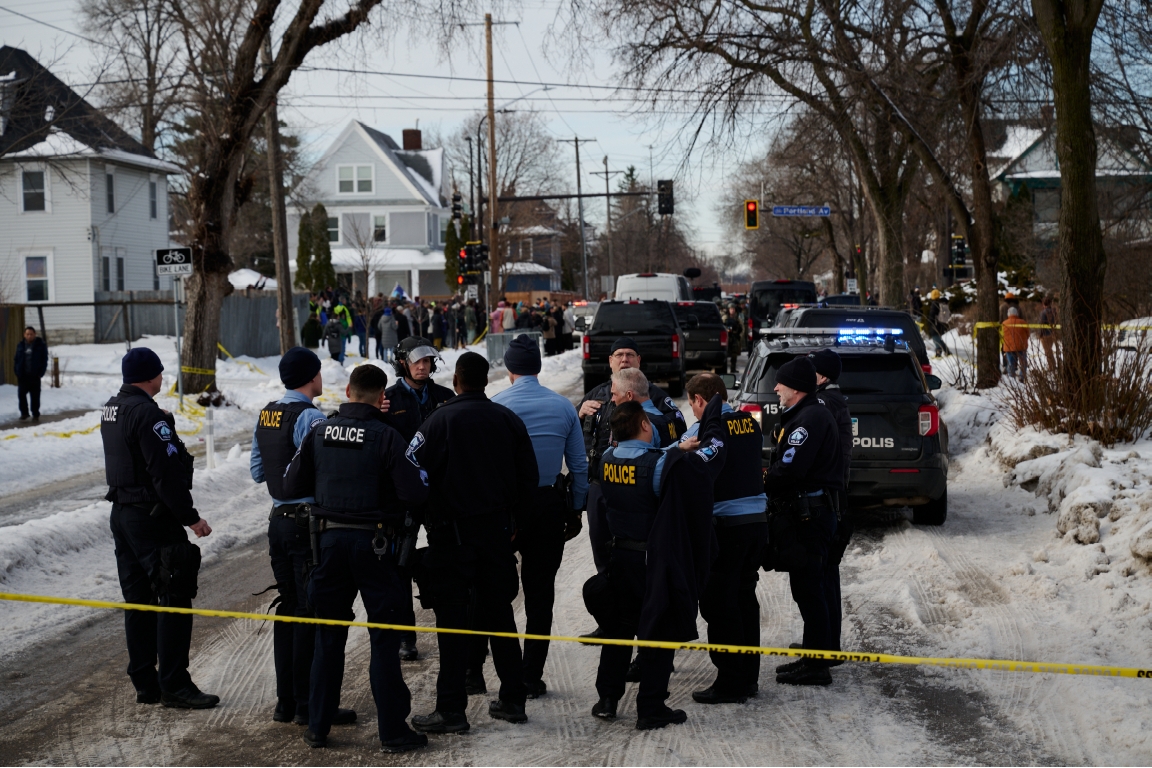
Nevertheless, protests over rising costs have been raging across the nation for two weeks, with some demonstrators calling for an end to Khamenei’s theocratic government.
U.S. Intervention?
U.S. President Donald Trump is openly mulling over military strikes. CBS reported on Sunday that he “was briefed on new options for military strikes in Iran.” Trump said that if the Iranian government kills its own people, “we’ll be hitting them very hard where it hurts.” Western media are already reporting that Iranian security forces “are opening fire on protestors nationwide.”
Iranian officials said that if the U.S. attacks them, they will hit American military bases in the Middle East. Iran’s parliament speaker, Mohammad Bagher Qalibaf, said, “In the event of an attack on Iran, both the occupied territory and all American military centers, bases and ships in the region will be our legitimate targets.”
While Western media have a vested interest in playing up the protests in Iran, even lying about them, reports of violence against protesters are widely corroborated, even by non-Western sources.
Pro-government Rallies
But one component Western media haven’t mentioned, or at least not a lot, is the pro-regime rallies happening in Iran. Former CIA analyst Larry Johnson, who also believes Iran is experiencing a CIA-Mossad color revolution, shared a clip of a pro-Islamic Republic rally in Mashhad.
“Yes, protests continue in some parts of the country, but Iranian security forces have taken off the gloves and are fighting back,” Johnson wrote. “Iranian officials have announced that the alleged ring leaders of the violent protests will be publicly executed starting Wednesday.”
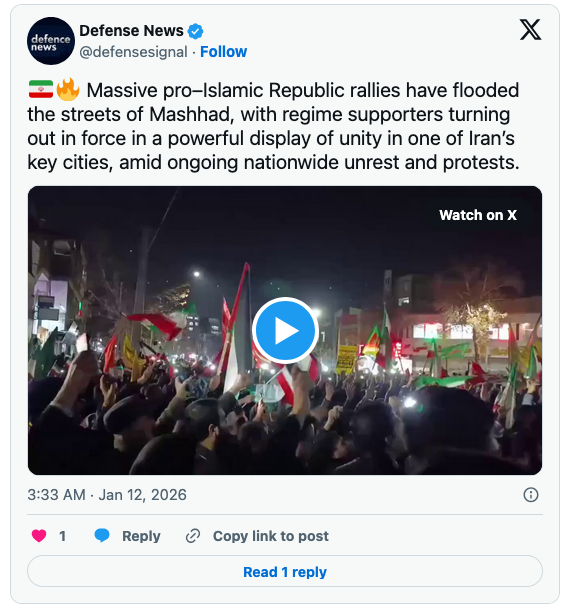
Some reports allege that the pro-regime protests were staged by Khamenei’s government to “to project an image of control and popular backing at a moment of visible strain.” According to Iran International, a Saudi-backed outlet, “authorities organized counter-rallies in several cities on Monday, presenting them as popular condemnations of the protests themselves.”
The initial protests began two weeks ago in Tehran’s marketplaces over complaints about the nation’s steep cost increases, a problem even Iran’s president acknowledged, according to reports.
Those protests have since spread, and demonstrators have clashed with authorities. According to the mayor of Tehran, protesters have burned down 25 mosques and damaged 26 banks, three medical centers, and 10 government buildings, along with over 100 fire trucks, buses, and ambulances.
The demonstrations are reportedly the largest since 2022. Some Western media outlets say that more than 500 people have died and more than 10,000 have been arrested.
America & Israel Support Regime’s Overthrow
Whatever the true count is, Israel and America are outwardly supporting the overthrow of the current regime, which has imposed an indubitably oppressive rule on the people there. Trump has broadcast his support for the protesters, saying, “Iran is looking at FREEDOM, perhaps like never before. The USA stands ready to help!!!”
And while he made it clear that America is not shy about getting involved, he said that “that doesn’t mean boots on the ground.” Nevertheless, it just so happens that there are 2,000 U.S. troops stationed next door in Iraq. There are also American troops with U.S. Central Command at Al Udeid Air Base in Qatar. And the Navy’s Mideast-based 5th Fleet is hanging out in Bahrain.
A U.S. official said cyber attacks could be among the options America may implement to help the Iranian protesters.
As for the Israelis, Prime Minister Benjamin Netanyahu said on Sunday that Jerusalem is watching very closely what’s happening in Iran. “We all hope that the Persian nation will soon be liberated from the yoke of tyranny, and when that day comes, Israel and Iran will once again be faithful partners in building a future of prosperity and peace for both nations,” he said.
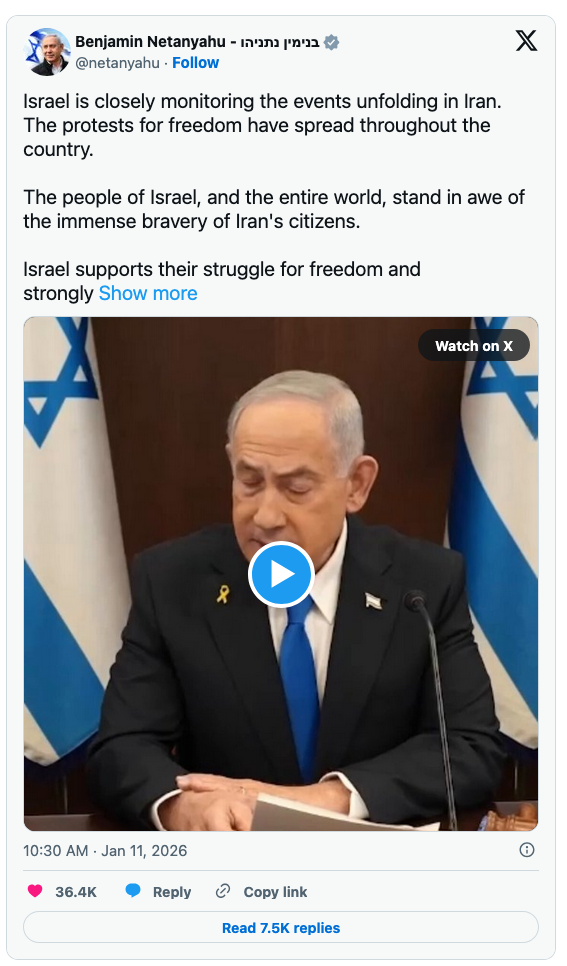
Netanyahu openly called for Iranians to overthrow their government when Israel launched its 12-Day War last summer, telling them in a video to take advantage of the pounding their rulers were taking from Jerusalem and overthrow Khamenei and his cronies.
On the Ground
Iranian officials allege that Israel and America aren’t just watching, cheering, and considering action — they’re on the ground already, fomenting trouble. It would be more surprising if that weren’t true.
Iranian Foreign Minister Abbas Araghchi recently said they have “a large amount of documents proving” that the Americans and Israelis are involved, according to Russian media. Araghchi claimed that armed instigators were embedded among real protesters, noting that many of the protesters killed were shot from behind. He also said they have much evidence that some operatives were taking direct orders from foreign powers.
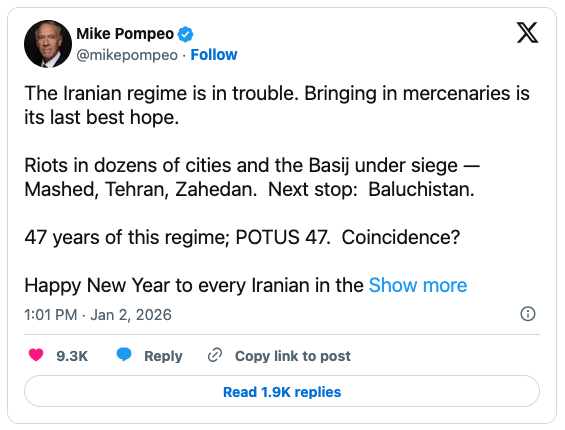
Araghchi also said that former CIA Director and Trump administration Secretary of State Mike Pompeo “admitted that agents of [Israel’s intelligence agency] Mossad were guiding the terrorist movement together with rioters.” He is likely referring to an X post Pompeo published January 2. “Happy New Year to every Iranian in the streets. Also to every Mossad agent walking beside them…,” he wrote.
Oil and Israel
It makes sense that the United States and Israel would want regime change in Iran. Israel considers Iran its primary threat in the region, and the two nations have been volleying threats — and attacks — back and forth for decades. Israel also suspects that Iran wants to build nuclear weapons to use against Jerusalem.
On the world stage, Iran is also one of the largest oil players. And Trump just admitted to removing the leader of Venezuela over oil.
Toppling of the Shah
If only Iran had a pro-Western regime, everything would be fine. That’s the idea, anyway. Except that it did — “until it was toppled with the help of the same U.S. foreign policy establishment recently beating war drums,” as author and researcher James Perloff pointed out in an older TNA article.
From 1941 until 1979, Iran was ruled by a constitutional monarchy under Mohammad Reza Pahlavi, Iran’s Shah. The Shah used Iran’s oil wealth to rebuild the once-great Persian nation. “Long regarded as a U.S. ally, the Shah was pro-Western and anti-communist, and he was aware that he posed the main barrier to Soviet ambitions in the Middle East,” Perloff noted. At home, the Shah allowed non-Muslims to practice their faith and granted rights to women.
But then, “the Shah suddenly became the target of an ignoble campaign led by U.S. and British foreign policy makers.” According to Perloff:
Bolstered by slander in the Western press, these forces, along with Soviet-inspired communist insurgents, and mullahs opposing the Shah’s progressiveness, combined to face him with overwhelming opposition. In three years he went from vibrant monarch to exile (on January 16, 1979), and ultimately death, while Iran fell to Ayatollah Khomeini’s terror.
Citing one of the Shah’s ministers and closest advisors, Houchang Nahavandi, Perloff writes that it was Henry Kissinger who wanted the Shah gone. “The process of toppling the Shah had been envisaged and initiated in 1974, under a certain Republican administration,” wrote Nahavandi:
Numerous, published documents and studies bear witness to the fact, even if it was not until the beginning of the [Jimmy] Carter administration that the decision was made to take concerted action by evoking problems related to human rights.
In the West, it was falsely reported that the Shah governed like a ruthless dictator. He was accused of suppressing political opposition through his secret police (SAVAK), which was known for torture, arbitrary arrests, and human rights abuses. U.S. Senator Ted Kennedy dubbed him “a despot, an oppressor, a tyrant.”
Western media fueled the campaign against him. Perloff notes how the revolution finally happened:
Two major events propelled the revolution in Iran. On the afternoon of August 19, 1978, a deliberate fire gutted the Rex Cinema in Abadan, killing 477 people, including many children with their mothers. Blocked exits prevented escape. The police learned that the fire was caused by Ruhollah Khomeini supporters, who fled to Iraq, where the ayatollah was in exile. But the international press blamed the fire on the Shah and his “dreaded SAVAK.” Furthermore, the mass murder had been timed to coincide with the Shah’s planned celebration of his mother’s birthday; it could thus be reported that the royal family danced while Iran wept. Communist-inspired rioting swept Iran.
According to the Shah himself, the United States basically ordered him to step down:
You cannot imagine the pressure the Americans were putting on me, and in the end it became an order…. How could I stay when the Americans had sent a general … to force me out? How could I stand alone against Henry Precht [the State Department Director for Iran] and the entire State Department?
Promoting Khomeini
Meanwhile, international support was being built for Ruhollah Khomeini, a cleric who didn’t like the changes the Shah had brought about, and also the mentor of Iran’s current supreme leader.
Riots and strikes ensued. A revolution erupted. And on February 1, 1979, Khomeini took power.
Terror immediately followed. Khomeini executed his opponents and slaughtered police officers suspected of loyalty to the Shah. “More Iranians were killed during Khomeini’s first month in power than in the Shah’s 37-year reign,” writes Perloff. “Yet Carter, Ted Kennedy, and the Western media, who had brayed so long about the Shah’s alleged ‘human rights’ violations, said nothing. Mass executions and torture elicited no protests. Seeing his country thus destroyed, the exiled Shah raged to an adviser: ‘Where are the defenders of human rights and democracy now?’”
So why did America’s foreign policy establishment betray their ally? Perloff suspects it came down to what it often does:
Iran ranks second in the world in oil and natural-gas reserves. Energy is critical to world domination, and major oil companies, such as Exxon and British Petroleum, have long exerted behind-the-scenes influence on national policies. The major oil companies had for years dictated Iranian oil commerce.
Quoting the Shah, Perloff writes:
In 1973 we succeeded in putting a stop, irrevocably, to sixty years of foreign exploitation of Iranian oil-resources…. In 1974, Iran at last took over the management of the entire oil-industry, including the refineries at Abadan and so on…. I am quite convinced that it was from this moment that some very powerful, international interests identified, within Iran, the collusive elements, which they could use to encompass my downfall.