


Broken System: 97-year-old Woman Breaks Hip, Told of 10-day Ambulance Wait, Found Dying on Floor
Here’s a story for you from what could be called the Warmth of Collectivism Files. A 97-year-old woman in Britain is diagnosed by a paramedic as having a broken hip. A serious injury such as that means you’re going straight to the hospital, stat, right?
Well, instead, the elderly woman is nonetheless told that she’s going to have to wait 10 days for an ambulance. In the interim, she suffers a fall.
She’s later found on her floor, struggling to breathe, and dies the same day.
So much for “to each according to his needs.”
Firstpost reported on the story Monday:
Babette Burge was found on the floor of her home in Newport, Isle of Wight, by a carer on October 19, 2025.
Five days earlier, a paramedic from a local GP surgery had assessed her and noted that her leg was “shortened and rotated,” a classic sign of a fractured hip, added the report.
Burge was scheduled for transfer to St Mary’s Hospital in Newport, but she suffered a fall before the ambulance could arrive.
Despite her advanced age, immobility, and the severity of her injury … [she was] informed that an ambulance to take her from her home to St Mary’s Hospital would not be available for ten days.
Burge died before the transfer could occur.
Priorities
So why weren’t there the resources to give this poor elderly woman one timely ride to one hospital? Coming to mind could be an immutable law of economics: Price caps (i.e., controls) lead to shortages. And, of course, socialized medicine seeks to limit costs with price caps.
But as the late Professor Walter E. Williams pointed out, there’s another problem with government-run entities. That is, a tendency toward practicing often bizarre discrimination (because without a profit motive, discrimination’s cost is no deterrent).
Suspecting this was a factor, commentator Olivia Murray provided her theory regarding where the resources went.
“Mohammed had a stuffy nose, Fatima was going into labor, and Ahmed was experiencing a khat overdose,” she wrote. “(I’m being facetious, but I’m probably not that far off, if at all.)”
She may not be, in fact, if a widely reported 2025 (the year Burge died) story is any indication. As GBNews informed last April:
Schemes to hand “asylum seekers” priority access to NHS treatment have sparked outrage after it emerged migrants are being given “preferential medical treatment” over British taxpayers.
But that’s not all. As Murray also writes, not being the least facetious, she uncovered another fascinating use of taxpayer healthcare money:
I discovered that for FY 2024/2025, the National Health Service spent around £205 billion — which equates to around £561 million, or more than half a billion pounds, each day. Then, I learned that the NHS, in recent history, ran a massive campaign to promote LGBTQ+ advocacy in the system, painting the ambulances with rainbows, and commissioning a gay doctor to design a rainbow badge for the NHS uniform; this badge was then mass produced for “friendly” employees and staff.
Relevant tweet below.
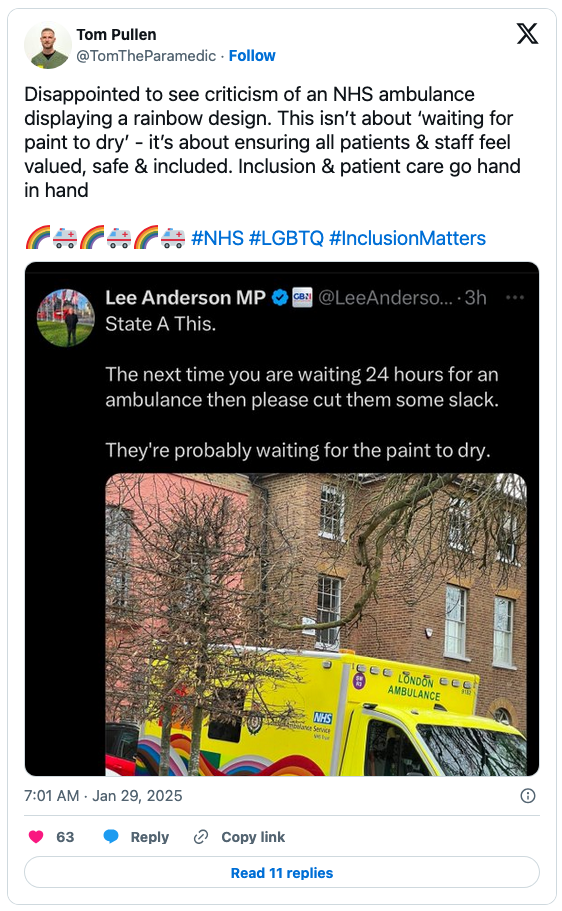
So “it’s about ensuring all patients & staff feel valued, safe & included,” the paramedic claims. Well, all right, then how about members of nationalist parties Reform UK or Restore Britain? Will they have their symbols on NHS vehicles? I mean, they’re an establishment-scorned minority. How about the 12,000 Brits a year punished for exercising “unapproved speech” in internet posts? Don’t these maligned people need to feel “valued”?
In reality, this has nothing to do making “all patients” feel “included.” For the establishment is drawing lines like everyone else. Rather, it’s about favoring a specific political/cultural agenda. Then there’s this:
How “valued, safe & included” did Burge feel when left to approach death cold, suffering, and alone on the floor?
More Socialized Medicine Realities
And while Burge’s case is an extreme one, it does reflect a long-standing socialized medicine reality. Just consider just a couple of relevant examples the aforementioned Williams provided in a 2009 article. After first addressing Britain’s medical system, he then moved on to Canada’s and wrote that,
after a Canadian has been referred to a specialist, the waiting list for gynecological surgery is four to 12 weeks, cataract removal 12 to 18 weeks, tonsillectomy three to 36 weeks and neurosurgery five to 30 weeks. Toronto-area hospitals, concerned about lawsuits, ask patients to sign a legal release accepting that while delays in treatment may jeopardize their health, they nevertheless hold the hospital blameless. Canadians have an option Britainers don’t: close proximity of American hospitals. In fact, the Canadian government spends over $1 billion each year for Canadians to receive medical treatment in our country. I wonder how much money the U.S. government spends for Americans to be treated in Canada.
Don’t bet that this has improved much since 2009, either.
Then Williams relates a story as bizarre as Burge’s, out of Sweden:
Mr. D., a Gothenburg multiple sclerosis patient, was prescribed a new drug.
His doctor’s request was denied because the drug was 33 percent more expensive than the older medicine. Mr. D. offered to pay for the medicine himself but was prevented from doing so. The bureaucrats said it would set a bad precedent and lead to unequal access to medicine.
Never mind that the drug might have brought this poor man some relief. Misery is OK as long as the pseudo-elites can pretend it’s equally shared. (That is to say, do you think a powerful Swedish government official would’ve been denied the medication?)
Moreover, and as I’ve explained repeatedly, “equality” is essentially an irrelevant measure. In a nutshell, equality tells you nothing about quality.
Regarding medical-system “solutions,” economist Thomas Sowell put it well. “There are no solutions,” he wrote. “There are only trade-offs.” Modern medicine is inherently expensive. You can look to cut those costs via government intervention, but not all costs are monetary. Some are measured in blood, sweat, tears, and heartbeats.