

DOJ Sues Harvard Over Refusal to Provide Documents That Prove Compliance With Civil-Rights Law
The Justice Department’s Civil Rights Division sued Harvard University yesterday because its far-left officials have refused to provide data and documents so DOJ can ensure it is not discriminating against some students because of race, apropos of 2023’s Students for Fair Admissions case.
That case outlawed affirmative action in admissions and was supposed to end discrimination against Asians at Harvard and the University of North Carolina.
The once-respected university — its reputation in ruins after major plagiarism scandals among diversity, equity, and inclusion hires, including its former president — must now answer charges that it is “slow-walking” releasing the data and otherwise refusing to cooperate with DOJ.
The Lawsuit
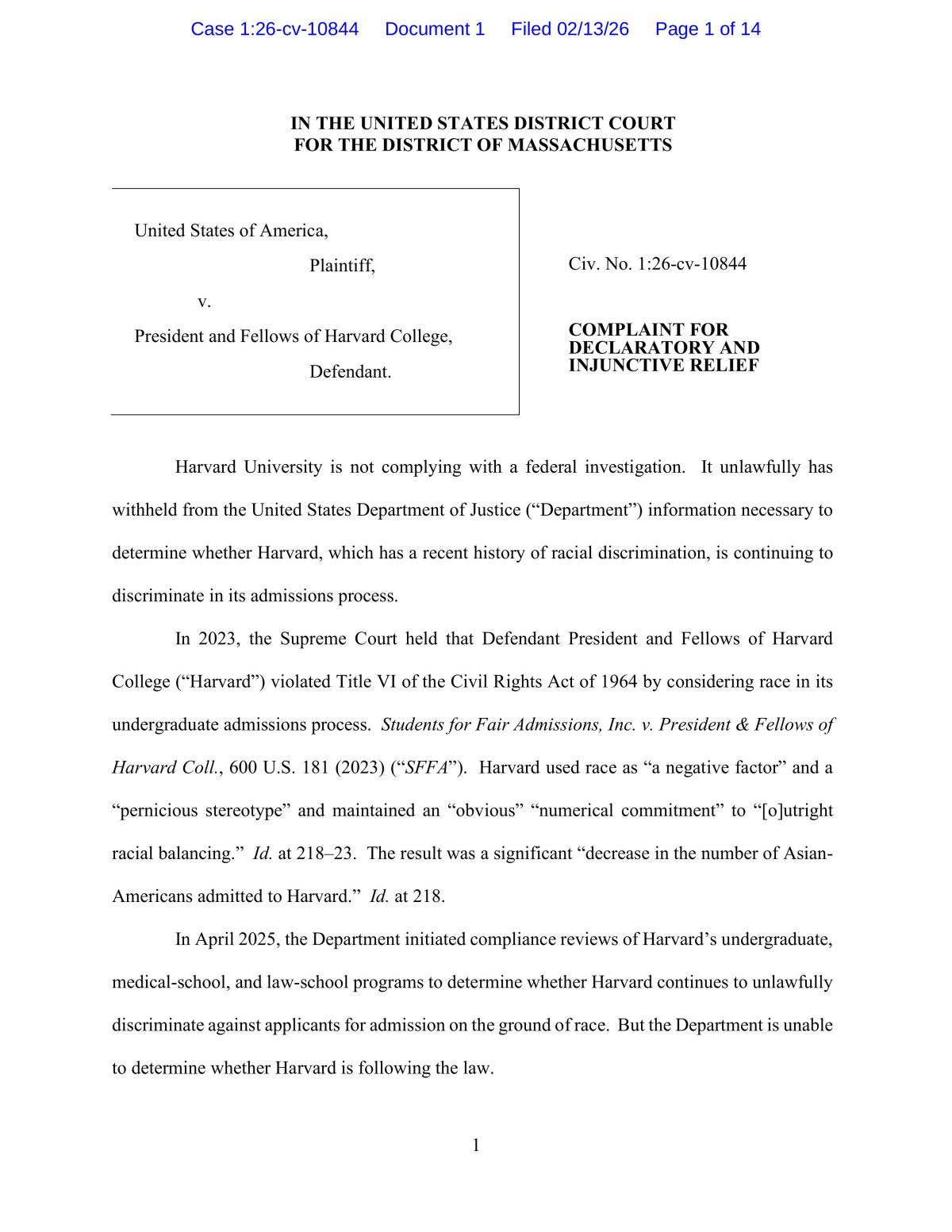
The 14-page complaint in the U.S. District Court in Massachusetts opens bluntly: “Harvard University is not complying with a federal investigation. It unlawfully has withheld from the United States Department of Justice (“Department”) information necessary to determine whether Harvard, which has a recent history of racial discrimination, is continuing to discriminate in its admissions process.”
In the Students for Fair Admissions case, the lawsuit notes, the U.S. Supreme Court ruled that Harvard violated the 1964 Civil Rights act by using “race as ‘a negative factor’ and a ‘pernicious stereotype’ and maintained an ‘obvious’ ‘numerical commitment’ to ‘[o]utright racial balancing.’”
Result: far fewer Asians at Harvard.
The SCOTUS ruling was clear. The court cited the plaintiffs case verbatim:
No State has any authority under the equal-protection clause of the Fourteenth Amendment to use race as a factor in affording educational opportunities among its citizens.
In April, DOJ began checking whether Harvard’s law, medical, and undergrad schools were complying with the ruling, or whether the university continued to discriminate.
Thus, the department requested that Harvard provide documents so the department could investigated, but alas, Harvard has refused to comply, which “violates federal law,” DOJ argues:
As a recipient of Department funding, Harvard is required by federal regulations and its own contract with the Department to cooperate with the Department’s compliance reviews. But at every turn, Harvard has thwarted the Department’s efforts to investigate potential discrimination. It has slow-walked the pace of production and refused to provide pertinent documents relating to applicant-level admissions decisions. Harvard made its most recent production of admissions-related documents in May 2025. The repeatedly extended deadlines for document production have long passed.
The lawsuit notes that Harvard’s endowment is almost $60 billion and that it charged more than $89,000 annually for undergrads. As well, it received $686 million in federal funding in 2024, 11 percent of its budget. Current grants amount to $2.6 billion, including $650,000 from DOJ.
But all that money comes with strings.
“As a ‘program or activity’ that receives federal funding, Harvard must comply with” federal civil rights law, which means the university “may not discriminate against any students on the ground of race,” the lawsuit continues:
Notwithstanding [those] requirements … and Harvard’s then-existing contracts with the federal government, which prohibited discrimination on the basis of race, Harvard recently discriminated on the ground of race in its undergraduate admissions.
Students for Fair Admission was supposed to right that wrong, but that not-insignificant fact aside, DOJ “has the right to review” the university’s compliance with federal law by scrutinizing its records, which in turn means the university must provide them.
As well, Harvard signed a contract committing it to providing the information from the three programs.
Yet “Harvard fails to cooperate with the Department’s investigation of its admissions practices,” the lawsuit alleged:
On May 16, 2025, Harvard made its initial production of documents. Of 916 documents produced, “most … were publicly available,” the lawsuit says, and “Harvard failed to produce many of the documents requested by the Department.”
Another document production on May 30 was also insufficient, as was another, which invited letters from DOJ on September 8 and September 12, each of which extended the deadline for producing the documents. And “after discussions with Harvard’s counsel, the Department agreed to one final extension of the deadline for production of Harvard Medical School documents until October 10, even though the United States first requested the admissions data nearly six months earlier.”
DOJ warned that it would not grant more extensions.
The lawsuit alleges that Harvard is not only withholding documents but also has breached its contract with DOJ linked to the grant. That contract said the university must provide “‘timely, complete, and accurate compliance reports’ … and ‘permit access’ to relevant documents.”
“Harvard further acknowledged that the Department may ‘review [its] practices,’” the lawsuit says.
DEI Plagiarists
Asians aren’t the only race against which Harvard discriminates. In May, Christopher Rufo of the City Journal exposed its anti-white discrimination. Rufo obtained internal documents that showed Harvard operates a DEI “machine” that systematically promotes women and minorities ahead of white men in faculty and administration positions.
“Internal documents … reveal Harvard’s racial favoritism in faculty and administrative hiring. The university’s DEI programs are more than ‘unconscious bias’ training,” Rufo wrote:
They are vectors for systematic discrimination against disfavored groups: namely, white men. As one Harvard researcher told us, “endless evidence” suggests that the university continues to discriminate against the supposed oppressor class in hiring and promotions.
A top Harvard doctor confirmed Rufo’s report.
The obsession with DEI led to numerous plagiarism scandals, including that which led to the resignation of DEI President Claudine Gay.