

Trump Says Iran War Over “Soon” as New Hardliner Takes Power
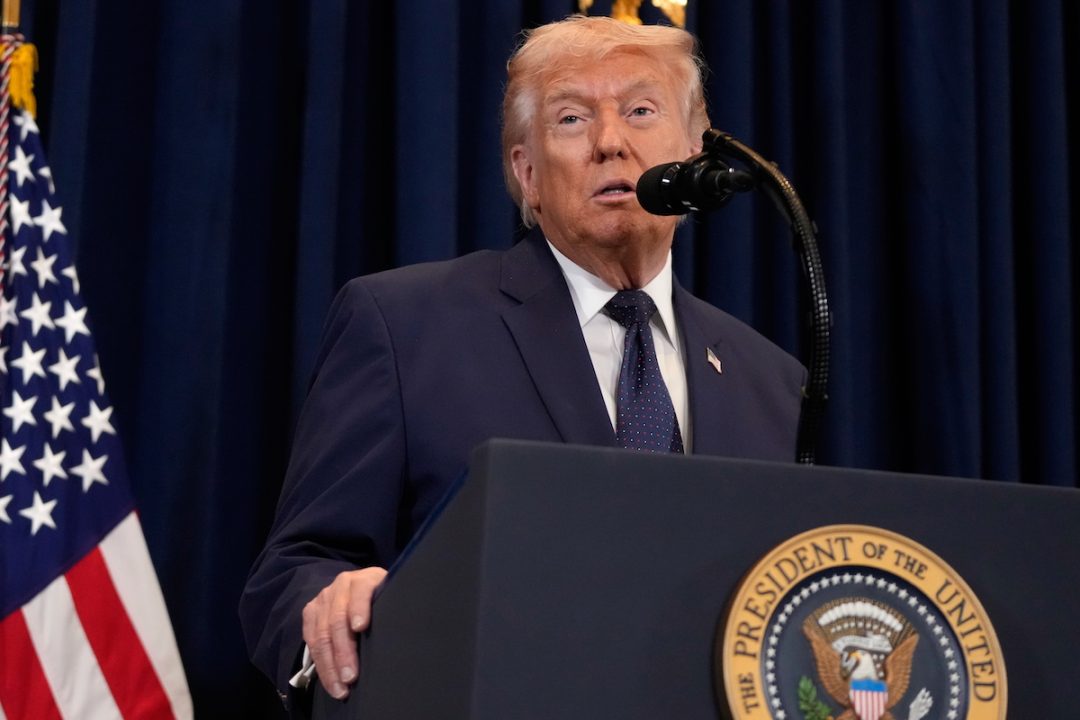
President Donald Trump suggested on Monday that the United States was winding down its war against Iran. He also implied that he’s open to ending U.S. participation and leaving the new hardliner cleric in charge.
“It’s going to be ended soon,” he said of the war during a press conference Monday afternoon. When a reporter asked when exactly Americans can expect it to end, he said it wouldn’t happen this week, “but soon … very soon.”
Meanwhile, Defense Secretary Pete Hegseth sent signals suggesting there’s still more intense fighting to come. “We will not relent until the enemy is totally and decisively defeated, but we do so on our time line and at our choosing,” Hegseth said during joint press conference with General Dan Caine, the chairman of the Joint Chiefs.
A reporter asked Trump about the mixed signals. Trump responded, “Well, I think you can say both.” He went through a long list of Iranian capabilities that have been destroyed. “We can call it a tremendous success right now as we leave here, or we can go further. And we’re going to go further,” Trump added.
Objectives Met?
In the press conference, Trump said America’s military objectives are “pretty well complete.” Most of Iran’s navy, about 51 ships, has been sunk. He said Iranian drone and missile production have taken big hits. He said more than 5,000 Iranian targets have been hit. Those attacks have resulted in an 83-percent drop in drone launches. He added that more than 90 percent of the Iranians’ missile launchers have been wiped out. “We’re ahead of our initial timeline by a lot,” the president summarized.
When asked what he meant when he said earlier that “we hadn’t won enough,” Trump said he was referring to America’s inability to completely eliminate the possibility of Iran getting back on track to developing nuclear weapons. It meant “when basically, I can see that they will no longer have any capacity whatsoever — for a very long period of time — of developing weaponry against the United States, Israel, or any of our allies.”
Earlier in the press conference, the president said Iranian leadership still wants to enrich uranium and to do so at “levels that are unacceptable.” He said they were working on restarting their nuclear program at different sites that will be more difficult to destroy.
This may very well be true, especially since Iran considers more than ever that nuclear weapons as a necessary defense. As others have pointed out, is it a coincidence that countries with nuclear weapons are seldom attacked?
More of the Same
Trump also addressed questions about Iran’s new supreme leader, Mojtaba Khamenei, who was selected over the weekend to succeed his father, Ayatollah Ali Khamenei. The elder Khamenei was killed on the first day of the war. Mojtaba Khamenei is considered a hardliner like his father. He has links to Iran’s Revolutionary Guard, the Islamic militant wing.
Trump refused to commit to the idea of “taking out” the new leader. He said:
I was disappointed because we think it’s going to lead to just more of the same problem for the country. So I was disappointed to see their choice.
This doesn’t mean the Israelis won’t try to kill the new supreme leader. Israeli officials are on record saying they are open to killing any leader they view as a threat.
Trump said he liked the idea of choosing a leader from “the inside,” yet someone the United States can work with. He said that proved possible in Venezuela. “We have a formula that’s been very good,” he said.
The president was asked if he was giving up on “helping the Iranian” people get their freedom. He hinted that he was. “We want a system that can lead to many years of peace, and if we can’t have that, we might as well get it over with right now,” Trump said.
Price Hike
Trump also addressed the steep spike in oil prices in America. Prices surged past $100 a barrel, to about $119, on Monday before retreating under the $100 mark after the president said the war would end soon. Before the war started, the price was about $70 a barrel.
The president vowed to keep the oil flowing through the Strait of Hormuz, which is a big oil conduit for Asian countries, including China. Reports emerged about five days ago saying that shipping had slowed to a “crawl” through the Strait of Hormuz. Citing the ship tracker MarineTraffic, NBC reported that traffic dropped by around 90 percent compared to the prior week. Reports say traffic has not resumed through the Strait of Hormuz.
Trump said the United States is waiving oil sanctions on certain countries to alleviate skyrocketing prices. He circled back to Iranian infrastructure targets he said earlier the United States opted not to hit. If Iran tried to stop the world’s oil supply from flowing, Trump said the United States would “take out those targets.” In the long run, world oil supplies will be more secure, he added.
Trump said the oil squeeze in the Middle East doesn’t “really affect” Americans, a false statement given the steep spike in gas prices Americans are experiencing. It’s true that very little of the oil that flows through that strait goes to America, less than three percent. But the market reaction has disproportionately affected gas prices in America.
Imminent Threat?
The president also made comments justifying the war in general. He said, “I thought they were going to attack us. If we didn’t do this at the time we did it, I think they had in mind to attack us.” Outside of trusting the president’s word, there’s no way to know if this is true. It seems illogical for Iranians to give the United States a reason to attack them, given that they’re greatly overmatched and would risk having their military capabilities decimated, capabilities they have been working on for decades. Moreover, there have been no intelligence assessments saying this is true — none that have been made public or leaked, anyway.
In his middle-of-the-night speech announcing the beginning of the war on February 28, Trump also alluded to Iran posing an imminent threat. Yet there’s been no evidence to support that, either. Iran doesn’t have nuclear weapons nor does it have long-range missiles or long-range bombers capable of leaving the Middle East, much less reaching the U.S. homeland. Their short-range capabilities do pose a danger to American assets in the area, but that wouldn’t be the case if American leadership was wise enough to leave the region completely.
The war has cost nearly a billion dollars a day, at least eight American lives, and 140 American injuries. It was launched without congressional approval and without the White House offering Congress proof that a war was justified. Moreover, it turns out the government knew before the war was ever launched that effecting regime change in Iran would be very difficult. A classified report by the National Intelligence Council said “that even a large-scale assault on Iran launched by the United States would be unlikely to oust the Islamic Republic’s entrenched military and clerical establishment,” according to reports. The report was available a week before Trump catapulted the country to war. As it turns out, the assessment was correct.
Fruits of Interventionism
So, what does the United States get for billions of dollars, eight American lives, and a spike in gasoline prices? The new leadership is just as radical, only younger. The people are still under the yoke of that same leadership class. And Iran is now only more determined to build nuclear weapons, tools it sees as necessary to its existence. Moreover, there’s no telling how many radical Islamic militant groups this operation will inspire. Killing the elder Khamenei likely ignited zeal against the West among people who previously weren’t paying attention.
Lastly, while Trump is hinting he’s ready to wind down the war, there’s no telling how America’s partner in this war, Israel, will react. Israel sees Iran as an existential threat. And perhaps they’re not open to ending the conflict until regime change has been effected. If that’s the case, will Israel continue? And if so, is the United States required to stay in as well? After all, Secretary of State Marco Rubio said outright that U.S. participation was triggered by Israel, who was going to attack regardless.
Until this war is officially over, Americans should not stop applying pressure to bring an end to it. This is an illegal war, a costly war, a careless and foolish escapade that was carried out without the permission of the governed. This is the stuff of monarchies and dictatorships, not representative governments.