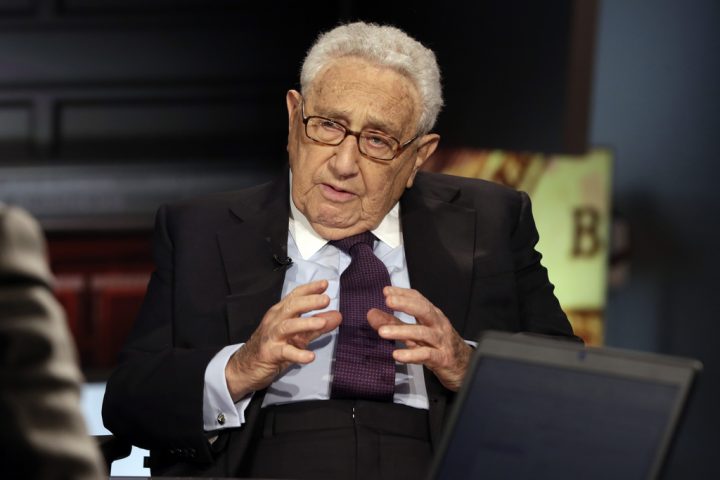
Former US Secretary of State and prominent architect of globalist American foreign policy for decades Henry Kissinger has passed away at the age of 100. Kissinger, who served as Secretary of State for both President Nixon and President Ford, was the primary architect of American rapprochement with Communist China, and was a major factor in legitimizing Mao Zedong’s murderous regime around the world, beginning with his infamous secret trip to China in 1971. Following that event, the free Chinese government on Taiwan was banished from the international stage and cut off from diplomatic ties with the United States, a callous act that set the stage for today’s increasingly belligerent Chinese behavior towards Taiwan.
If there is a world war over Taiwan and the South China Sea, it will be as much a consequence of Kissinger’s actions as anyone’s — yet now that he belongs to the ages, he will never be held accountable by any earthly authority.
Moreover, Kissinger helped to initiate the policy of détente with the Soviet Union, and was awarded the Nobel Peace Prize for his role in negotiating the peace accord that ended the Vietnam War. To his many admirers, Kissinger was the quintessential modern foreign policy panjandrum, but to his many detractors — including this magazine — he was both an unrepentant communist sympathizer and amoral advocate of globalism. As even liberal journalist Seymour Hersh pointed out, “the dark side of Henry Kissinger is very dark.” Kissinger himself once famously stated that “power is the ultimate aphrodisiac.”
Yet despite his obvious loyalty to causes antithetical to decency and to American national interests, Kissinger exerted enormous influence over his long life; indeed, it is no exaggeration to say that we live in Kissinger’s world, inasmuch as we are still suffering the long-term consequences of the globalist agenda and of our decades-long national love affair with Communist China for which Kissinger brokered the first trysts. Only last July, shortly after celebrating his centenary, Kissinger met with Xi Jinping in Beijing, who received the German-American diplomat with undisguised admiration.
Whether Kissinger ever had occasion to second-guess his life’s course is doubtful. Known for his enormous ego, he candidly told Time magazine more than 40 years ago that “the longer I am out of office, the more infallible I appear to myself.”
For more information on the man veteran reporter Bill Jasper called “the eminence grise of the globalist Establishment,” see Jasper’s article in The New American, published on the occasion of Kissinger’s 100th birthday.