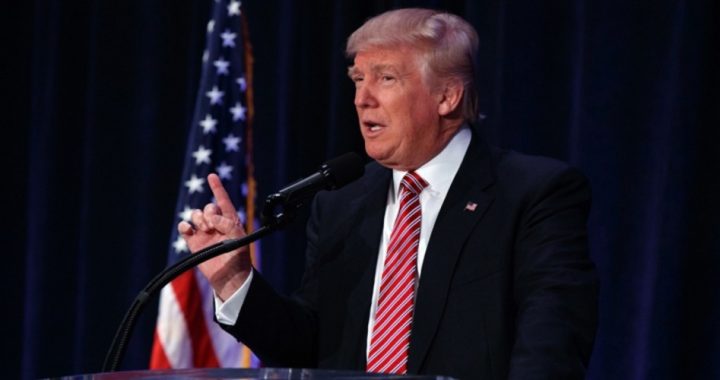
“I don’t want to have people that are unfair,” Republican presidential nominee Donald Trump told radio host Hugh Hewitt this week. “When you look at what Candy Crowley did with, you know, with Mitt Romney, that was so unfair. And she was wrong on top of everything.”
Since their introduction into the process in 1960, televised presidential debates have played an important, and sometimes decisive, role in the outcome of the election. It is considered likely that the 1960 presidential debates between then-Senator John F. Kennedy and Vice President Richard Nixon tipped the election scales in Kennedy’s favor.
Nixon had been ill, and his haggard appearance is thought to have hurt him. While a majority of those who watched the debates on TV thought Kennedy won them, radio listeners believed Nixon did better. Not surprisingly, Nixon declined to participate in any such debates in 1968 or 1972.
Ronald Reagan’s performance against incumbent Jimmy Carter probably contributed to his 1980 victory, as did Bill Clinton’s superior debate performances against George H.W. Bush and Bob Dole in 1992 and 1996, respectively. And who can forget Al Gore’s incessant sighing in his debate with George W. Bush in 2000, or when Gore, for some reason, walked from his podium almost into Bush’s face, while Bush was answering a question. Gerald Ford’s perplexing denial that Poland was under Soviet domination during his 1976 debate with Carter may very well have made the difference in that close election, as well.
In contrast, in 1984, when Reagan’s age (and poor performance in the first debate) was the only realistic chance for Walter Mondale to defeat the incumbent president, Reagan defused the issue with a humorous one-liner. Responding to a question about whether his age should be of concern to the voters (Reagan was 73 years old at the time), Reagan famously retorted that he was “not going to make age an issue,” and would not make an issue of Mondale’s “youth and inexperience.”
In such debates, such “moments” are all the most voters will ever remember before they trudge to the polls. So, in these debates, candidates must avoid a “gaffe” that will cost them the election.
But, while no one would argue that the moderators in the multiple presidential TV debates held since then have favored the Republican candidate, nothing quite like what Trump referenced about the 2012 debates had happened before. And it explains why Trump is cautious about who will moderate this year’s debates.
In 2012, CNN anchor Candy Crowley interjected herself into the debate between President Barack Obama and former Massachusetts Governor Mitt Romney, the Republican nominee. Following the September 11, 2012, attack upon an American diplomatic compound in Benghazi, Libya, the Obama administration took great care to insist that the attack was not the result of a terrorist attack, but rather a spontaneous demonstration against an anti-Muslim video. Four Americans, including the U.S. Ambassador to Libya Chris Stevens, U.S. Foreign Service Information Management officer Sean Smith, and two former U.S. Navy Seals, Glen Doherty and Tyrone Woods, were killed in the attack.
In a string of interviews, including on CBS’ Face the Nation, ABC’s This Week, and Fox News Sunday, UN Ambassador Susan Rice discounted that the attacks were terrorism, insisting, “We’ve decimated al-Qaeda.” Instead, Rice called the attack a direct result of a “heinous and offensive video,” which ridiculed the Islamic religion, and especially its prophet, Muhammad.
This was important, because the Obama administration was touting its supposed success in destroying the ability of terrorists to attack America, highlighted by the killing of Osama bin Laden. Since the Benghazi attacks occurred on the 11th anniversary of the infamous attacks upon the World Trade Center and the Pentagon, it was understandably assumed that they were planned terrorist attacks, to mark that anniversary.
But Obama was in the middle of a tight reelection campaign, and a key part of the strategy for reelection was making sure the voters believed Obama was ending the terrorist threat to America. Therefore, the Obama White House promoted the narrative that the attack was not an organized act of terror, but rather the result of anger over a video. Obama, Secretary of State Hillary Clinton, and others in the administration essentially argued for the same explanation given by Rice.
It was widely conceded, even by Obama, that Governor Romney had done a better job in the first presidential debate, and, in fact, Romney was thought to have actually surged ahead in the contest for the White House. The controversy over the Benghazi narrative put out by the Obama administration threatened Obama’s reelection.
During the October 16 debate, Romney zeroed in on this effort by Obama to downplay the Benghazi attacks as terrorism, charging that it took Obama 14 days to call it what it was — “an act of terror.”
At that point, Obama interrupted Romney with, “Get the transcript.”
Then, something happened that had no precedent in a presidential debate. The moderator, Candy Crowley, entered the debate on the side of Obama, saying to Romney, “He did in fact, sir. So let me call it an act of terror.”
Romney was thrown off by the unprecedented intervention by a moderator, and it clearly affected the rest of his debate performance. And, the momentum in the campaign, which had been going Romney’s way, swung back to Obama.
Amazingly, Obama delivered a speech to the United Nations on September 28, 2012, in which he was still promoting the idea that the attack was not an act of terror, referencing instead “a crude and disgusting video [which] sparked outrage throughout the Muslim world.” Even more incredible, Crowley herself had reported that the president was slow to call the attacks terrorism, which means that her moderator performance contradicted her own earlier reporting!
So, Trump’s caution concerning just who will be the debate moderator appears to be warranted. And it is clear that the mainstream media dislikes Trump far more than they disliked Romney. Trump has told multiple reporters, including radio host Hugh Hewitt and Fox News’ Greta Van Susteren, that he wants to do the debates, but is concerned about facing a moderator biased against him. Trump told Hewitt that he thinks Lester Holt of NBC News “is a good guy,” but he did not want CNN contributor Mary Katharine Ham included. “I’ve never gotten along with her, no. No, she is not a fan of mine, and I’ve never gotten along with her … she says only bad things, so let’s cross her name off.”
Hewitt told Trump that while Crowley was “wrong” in what she did to Romney, he did not think Chuck Todd would do anything similar. Hewitt also added that he thought Jake Tapper, Dana Bash, or Wolf Blitzer of CNN would be fair.
In his discussion with Van Susteren, he told her that a “fair moderator” is “all I’m looking for.” Another concern that Trump expressed was that he did not think it was good to schedule the debates at the same time as NFL games.
“But I think that debates between the two of us would be very good. I think it’d be very interesting. I think it’s going to be very revealing for the public, and I look forward to it, but I would think something like what we had with the Republican debates or what they had with the Democrat debates.”
Trump told Newsmax TV host J.D. Hayworth, “We want a moderator that’s going to be fair. If we have a fair moderator, then it’s going to be wonderful,” and added, “So, I look forward to the debates, but we certainly want to negotiate things — moderators being one of them.”
Photo: AP Images